For generations of Barcelona residents and expats, the skyline of Catalonia’s capital has been defined by a permanent fixture: a forest of construction cranes surrounding the unfinished spires of Antoni Gaudí’s masterwork.
Yet, as the city honours the centenary of the legendary modernist architect's death, a dramatic engineering breakthrough has reshaped the skyline. The basilica’s six central towers have finally reached their full height. The crowning achievement—the towering 172.5-meter Tower of Jesus Christ—officially secures the Sagrada Família's position as the tallest religious building in the world, eclipsing Germany's Ulm Minster.
While the dramatic, crystalline stone structures appear to hold themselves up by divine intervention, architects have revealed the unseen hero behind this historic milestone: 24 metric tons of high-performance industrial adhesive.
The Modular Leap: Fusing Stone and Steel
Gaudí knew completing the basilica would be a multi-generational battle of time against imagination. What he could never have anticipated was a decade-long technological partnership with German engineering that accelerated construction tenfold, cutting a staggering 40 years of manual labour from the building schedule.
To bypass the agonisingly slow pace of traditional stone masonry at extreme heights, engineers shifted to an advanced modular building system.
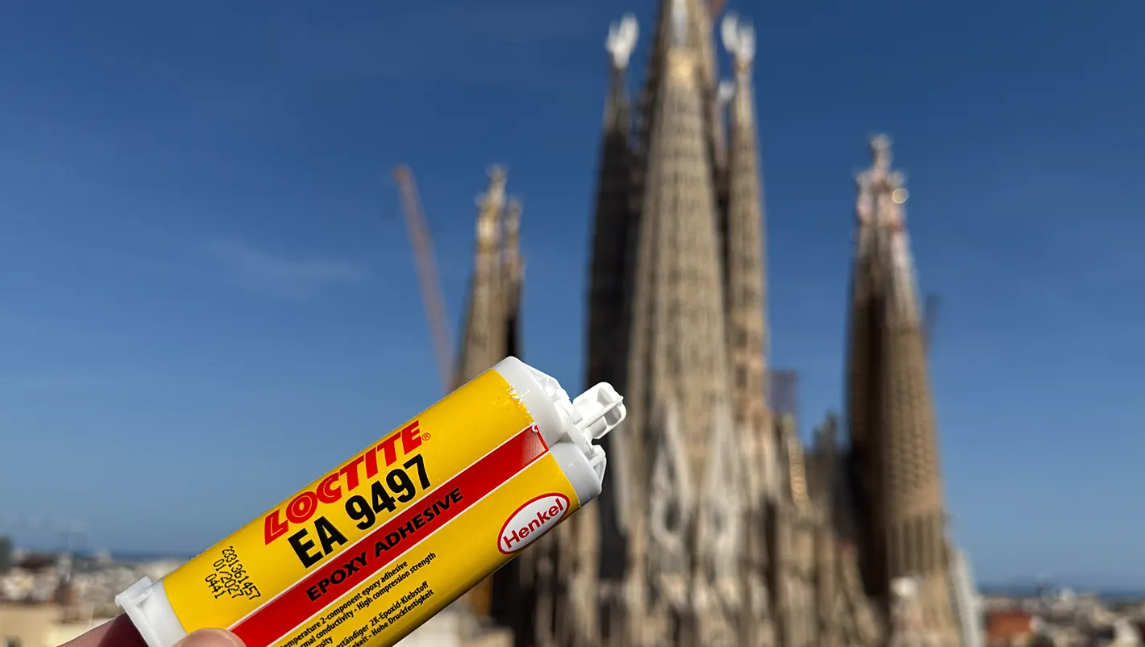
The six central towers are assembled from 826 prefabricated panels incorporating more than 2,100 massive stone elements. To turn these separate blocks of stone and internal structural steel rods into a single, unbreakable monolithic unit, builders applied an average of 30 kilograms of specialised structural adhesive (Loctite EA 9497) to each panel.
Injected in liquid form, the adhesive flows deep into the microscopic cavities of the stone, adapting perfectly to the jagged surfaces before undergoing a strict 24-hour thermal curing process. Once set, the bond becomes entirely inert, structurally fusing the two materials together.
Engineering for Extreme Mediterranean Conditions
Building the world's tallest church spire is hard enough, but Barcelona’s coastal microclimate presents an absolute nightmare for structural engineers. The adhesive had to prove it could survive a gauntlet of environmental threats:
Corrosive Marine Air: Sitting just 2.5 kilometres from the Mediterranean Sea, the structure is assaulted by a constant, saline-heavy breeze that accelerates the corrosion of traditional mortar and exposed metal.
IT-Online
Extreme Thermal Swings: Barcelona's high relative humidity (frequently hitting 65% to 75%) combined with seasonal temperature shifts ranging from 5°C in winter to over 30°C in summer causes continuous structural expansion and contraction.
Subterranean Shocks: Two major urban metro lines run directly alongside the basilica’s foundations, sending a relentless, low-frequency vibration up through the stone pillars 20 hours a day.
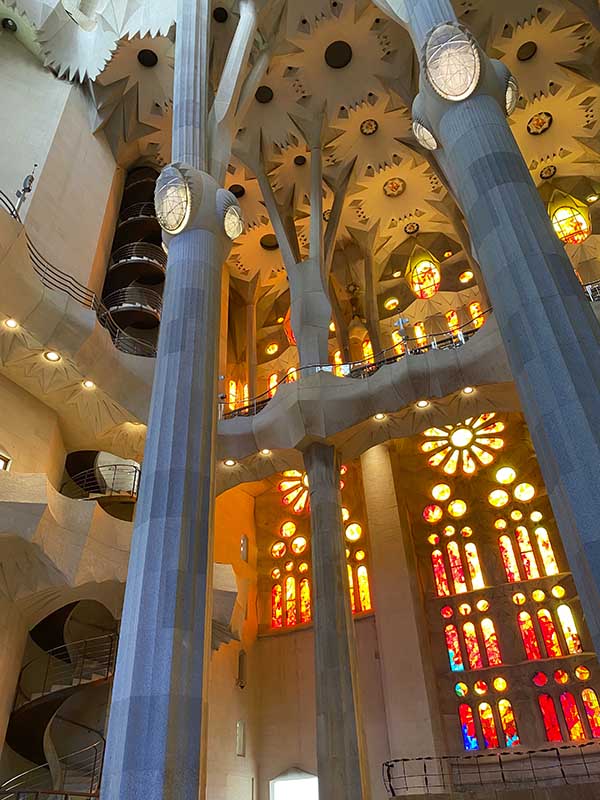
The resulting bonded structure is an engineering marvel. It is rated to withstand loads equivalent to 100,000 people per square meter—roughly the entire capacity of FC Barcelona’s nearby Camp Nou stadium. It is this jaw-dropping structural integrity that allows the central spire to safely support the massive 17-meter-tall, 12-ton crystalline cross that now crowns the city's skyline.
The Verdict for Visitors
Following the recent formal blessing of the central spire, the structural scaffolding is steadily coming down. For the first time in nearly a century and a half, the grand geometric vision Gaudí left behind in plaster models is fully visible to the naked eye.
The next phase of the project focuses on finishing the interior of the central tower, which will house a spiral staircase and a panoramic glass elevator designed to whisk visitors up to a breathtaking viewpoint 164 meters above the streets of Barcelona.
What do you think about using cutting-edge chemical adhesives to finish a historic 19th-century cathedral? Does it compromise the traditional spirit of the building, or is it a brilliant triumph of modern engineering? Let us know your thoughts in the comments below.