History in Spain isn't confined to dusty museum basements. It hits you the moment you walk past a 2,000-year-old Roman aqueduct on your way to grab lunch, order a tapa of cured ham born from centuries of religious identity, or admire the stark horseshoe arches of a southern gateway.
To truly understand the country, you have to look at the landscape as a giant, beautifully layered cultural mosaic. Here is a cheat sheet to 3,000 years of Spanish history—the essential narrative arcs that shaped the peninsula into what it is today.
1. The Ancient Coastlines: Phoenicians, Greeks, and Carthaginians
Long before "Spain" existed as a unified concept, the Iberian Peninsula was a melting pot of indigenous tribes (the Iberians and Celts) and wealthy eastern Mediterranean traders.
-
The Phoenicians: Sailing from modern-day Lebanon, these maritime masters established trading colonies along the southern coast around 1100 BC. They founded Gadir (modern-day Cádiz), making it the oldest continuously inhabited city in Western Europe.
-
The Greeks: Set up competing trading posts along the northeast coast, introducing olive trees and vineyards to the region—foundational elements of the local culture.
-
The Carthaginians: Hailing from North Africa, they eventually took control of the south, establishing Carthago Nova (Cartagena) as a major military stronghold.
2. Roman Hispania: The Empire's Golden Province
The Romans arrived in 218 BC, primarily to defeat their Carthaginian rivals during the Punic Wars. They liked the peninsula so much that they stayed for six centuries, naming it Hispania.
Phoenician/Greek Traders ➔ Roman Conquest (218 BC) ➔ 600 Years of Imperial Rule
Hispania quickly became an economic engine for Rome, exporting vast quantities of gold, olive oil, wine, and garum (a prized fermented fish sauce). But the province also left its own indelible mark on the Empire, producing the great philosopher Seneca and three Roman Emperors: Trajan, Hadrian, and Marcus Aurelius.
Where to see it today:
-
Segovia: The breathtaking Roman aqueduct that bisects the city centre.
-
Mérida: A stunningly preserved theatre, amphitheatre, and circus.
-
Lugo (Galicia): The only city in the world still completely encircled by its original Roman defensive walls.
3. The Visigoths and the Muslim Conquest
As the Roman Empire collapsed in the 5th century, Germanic tribes swept across the Pyrenees. The Visigoths eventually established a unified Christian kingdom spanning most of the peninsula, with their capital at Toledo.
However, internal political instability left them vulnerable. In 711 AD, a Muslim army composed of Arabs and Berbers crossed the Strait of Gibraltar from North Africa. Within a few short years, they overran the Visigothic kingdom, pushing the remaining Christian lords into the rugged, rainy mountains of the far northern coast (Asturias).
4. Al-Andalus and the Golden Age of Coexistence
The Muslim territory, named Al-Andalus, evolved into one of the most sophisticated civilisations of the Middle Ages. While Northern Europe struggled through the Dark Ages, the Caliphate of Córdoba became a global beacon of science, medicine, philosophy, and agriculture.
The Concept of Convivencia: For centuries, Al-Andalus was famous for a degree of "living-together-ness" where Muslims, Christians, and Jews coexisted in relative peace, fostering an incredible intellectual and cultural boom.
The Moors introduced advanced irrigation systems, paper-making technology, and ingredients that define local cuisine today: rice, saffron, citrus fruits, almonds, and sugar cane.
The Footprint:
As Christian kingdoms in the north gradually pushed southward over a 700-year period (a process known as the Reconquista), they inherited this rich architectural heritage. This resulted in Mudéjar architecture—a style unique to Spain where Christian buildings were constructed using Islamic geometry, brickwork, and decorative tiling.
5. 1492: The Turning Point of the Modern World
The year 1492 is arguably the most monumental year in the country's history, driven by three explosive events under the "Catholic Monarchs," Fernando of Aragón and Isabel of Castilla:
-
The Fall of Granada: In January, Christian forces captured Granada, the last remaining Islamic kingdom on the peninsula, ending 700 years of Moorish rule.
-
The Expulsion: In March, seeking a uniformly Catholic state, the monarchs ordered all Jews to convert to Catholicism or face immediate expulsion. A similar decree was later forced upon the Muslim population.
-
The New World: In August, Christopher Columbus set sail under the Spanish flag, accidentally stumbling upon the Americas and launching the Spanish Empire.
6. Imperial Glory, Inflation, and Decline
During the 16th and 17th centuries, Spain became a global superpower. Gold and silver from the Americas flooded into its ports, funding jaw-dropping cathedrals, palaces, and a golden age of art (producing figures like Cervantes and Velázquez).
However, this wealth proved to be a curse. Instead of developing domestic industries or diversifying agriculture, the Habsburg rulers spent their fortunes funding endless religious wars across Europe. The influx of silver triggered hyperinflation, and the expulsion of the industrious Jewish and Muslim populations left fertile agricultural lands (especially in Valencia) untended. By the 18th and 19th centuries, the empire had lost its grip on its global territories, slipping into relative economic isolation.
7. The 20th Century: Tragedy to Modern Triumph
The modern history of the peninsula is defined by extreme volatility that eventually gave way to one of the most successful democratic transitions in modern history:
-
The Civil War (1936-1939): A brutal conflict between the democratic Republicans and General Francisco Franco’s Nationalist forces left the country devastated.
-
The Dictatorship (1939-1975): Franco ruled with an iron fist for nearly four decades, enforcing strict cultural uniformity and economic isolationism.
-
The Transition: Following Franco’s death in 1975, a political miracle unfolded. The country smoothly transitioned to a constitutional democracy, opened its borders, joined the EU, and rapidly modernised its infrastructure.
The Takeaway: A Land of Many Realms
Understanding this timeline helps explain why the country is so delightfully complex today. It explains why a nation of 17 autonomous regions can feel like multiple countries rolled into one.
Galicia shares Celtic roots and green landscapes with Ireland; Catalonia and the Basque Country maintain entirely distinct languages and cultures, while Andalusia proudly wears its Moorish history on its sleeve. When you travel the peninsula, you aren't just moving between provinces—you are walking through a living museum of human civilisation.
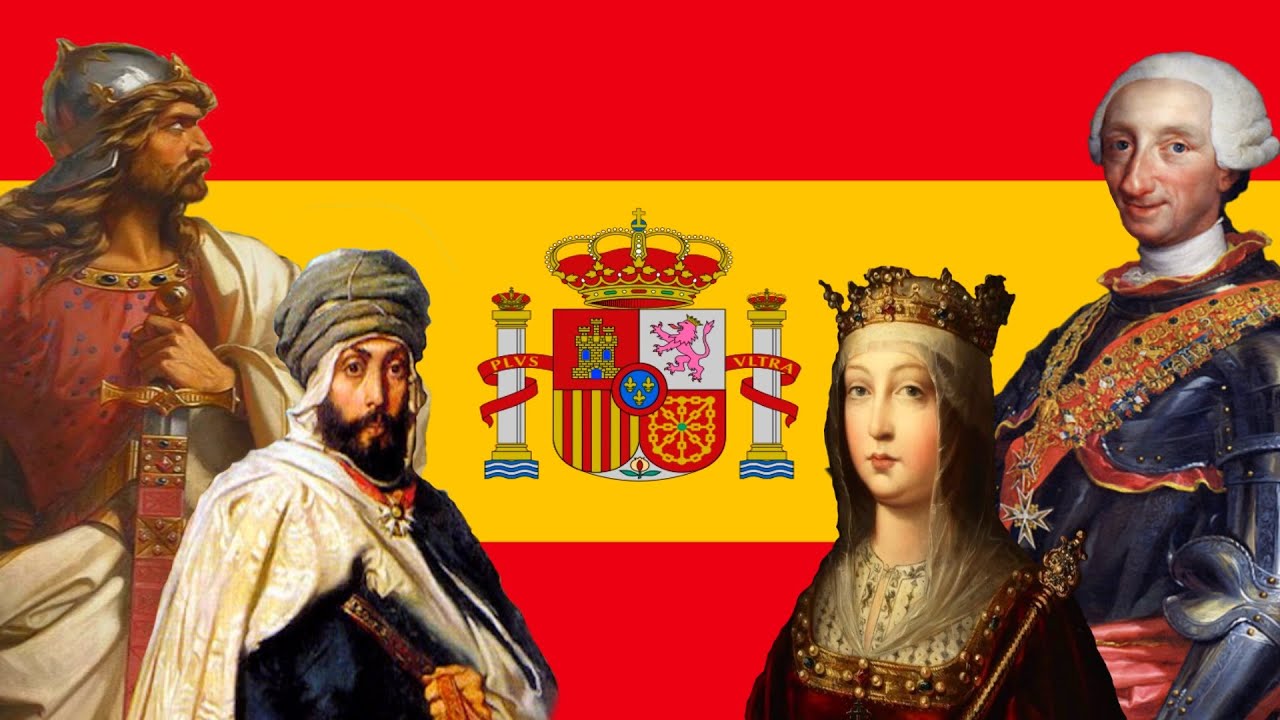
For those who want a swift, structured visualisation of these shifting centuries, this short video tracking Spain's timeline maps out the main periods from Roman Hispania through to the modern era in a highly condensed format.