The Senior Citizens' Lunch Engagement
Saturday, October 10, 2026
I invited myself to the Senior Citizens lunch-date last week held in one of our finest hotels. To do this, one only needs to discover that the town hall has its annual free treat for the over-65s and to know to drop by the secretary’s office in due time to pick up a ticket.
All rather fun, I’d not been before.
I’ve become a trifle deaf – it comes with age I suppose. At least I still have my hair and teeth, or at least, most of them anyway. Although it might go in some way towards explaining why nothing in the giant array of serve-yourself food was crunchy.
The queue outside was designed to be barged, so we all did – creating a tight-to-fit blockage at the door into the dining hall. Once past the ticket-inspector, I joined the noisy throng looking for somewhere to sit.
The first person I saw was Doña Beatriz, who had kindly mentioned me during her speech as la pregonera at the opening of the village fiesta back in August. I thanked her for her kind words. We foreigners often tend to get overlooked.
Then casting about, I suddenly heard my name hooted across the room, so found my way to an empty chair next to a British friend, who like me, is an old-timer here in our community.
Janie once worked as an air hostess for a zeppelin, so I was pleased to see her, and indeed hear her voice rise above the herd.
The Spanish are a noisy race, and their refectories are designed to echo appealingly to encourage the cacophony – hard walls, lots of massive windows and a tiled floor. According to my friend Colin, who writes a daily blog from Galicia, a ‘noisy bar’ is a tautology in Spain, he says, since there’s no other kind. Apparently, when we are young, our hearing can distinguish what we want over the roar from what we don’t – known perhaps as ‘the cocktail party effect’. Sadly, this useful skill diminishes as one gets older.
Thus, many of us ancients were sufferers of hearing-loss. Two hundred or so pensioners bellowing across the tables at each other. Even my friend from the airship, who had once long ago been trained to project her voice across forty metres of companionway, was obliged to give it her all as she asked me politely for the salt.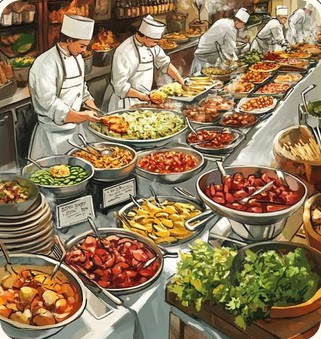
We went to fill our plates, after all, a free meal at a buffet means ‘pile them high’. Three times to the trough and back. I bumped into the mayor on the second visit (he was the only person there who was underage) and thanked him for the lunch. One of the racier old girls filling her plate next to me asked who he was: ‘he’s a handsome looking cove’ I think was what she said.
A merry session, a hearty scoff and a glass of wine (one must be careful these days) and so I took my leave, slightly nonplussed as to what was the point of this luncheon. There were no speeches or prize-giving or a raffle for a brand-new coffee-machine from the local white-goods emporium or maybe a colourful painting of our village from the schoolchildren.
I went outside – ah bliss! So quiet I could hear a pin drop.
......
Each week, I post a blog called Business over Tapas with useful news about Spain. It has the editorial I've posted here - usually - plus a number of short items of interest together with their links to sources. There are no adverts and no fluff.
 3
Like
Published at 7:32 AM Comments (1)
3
Like
Published at 7:32 AM Comments (1)
Pros and Cons: Who will be Left Standing After the Elections?
Wednesday, October 7, 2026
So, who will win? Gosh, that's a hard one.
A few thoughts. 
There are some poor working-class Spaniards who might vote conservative - that's to say - Partido Popular - in the idea that this would attach some cachet to them, elevating them psychologically to the middle-class. We've seen it in Andalucía, a traditionally socialist region, dominated by the Madrid aristos known as los señoritos - the little gentlemen. It's also true that there were some shockingly corrupt and inept PSOE politicians coming from Seville (from Felipe González to Manolo Chaves). Whether one can vote PP (or Vox) in the regional elections, and then turn around and vote PSOE in the national elections will be seen in due course.
Those of the working class who, perhaps indignant at the number of foreigners in Spain, or the Ceuta situation, and who would put their vote with Vox are known as fachapobres: poor fascists.
A Spanish friend tells me that there are a lot of people who don't like foreigners, or Muslims, or black people. The poor ones, anyway. This is a card played by the far-right worldwide. The immigrants want to take your cookie.
But then there's Alberto Núñez Feijóo, who is generally thought to be a mediocre politician, without much apparent presence or intelligence. Feijóo of course won't be winning alone - he'll need Santiago Abascal behind (or beside) him. The handsome and bearded Abascal at least looks the part - and his party, heavily dependent and close to Trump, Milei and other authoritarian figures from abroad - has seen a considerable surge over the last year.
Compared with Sánchez, generally seen at least outside Spain as 'a statesman' and who speaks English and French, Feijóo is painfully inept. The pyrrhic victory of the viviendas last week exploded in his hands as many thousands of Spaniards demonstrated against the high rents, evictions and bank- and vulture-fund greed moved into tents in several cities - followed by the reversal (or re-reversal) of the housing rules under the caretaker government on Tuesday.
Other advantages for Sánchez (and the parties to his left) include the ruling that, after all, the offspring of those Spaniards (with Spanish passports) who left Spain during the Franco years will be able to vote - despite the strong opposition of the PP/Vox. How many will feel suitably slighted by having their rights threatened remains to be seen - and after all - they almost all live in countries with far-right governments (Argentina, Chile, Ecuador, Colombia and so on). These expatriate Spaniards are listed under the Census of Spaniards Resident Abroad (CERA) number about 2,748,000.
Maybe 10% or 15% will bother to vote. Perhaps it won't make any difference. In the 2023 general elections, some 24,950,000 Spaniards voted. Probably more will do so this time.
Those angered by the manoeuvre to stop the new housing laws of earlier this month by the PP, Vox and the Catalonian Junts spread to the streets and are now ready, with the major CCOO and UGT unions, plus their own Sindicato de Inquilinos, for a General Strike on November 11th. This will bring votes to the socialists, who have already – as above – switched defeat into a temporary victory (to be ratified or repealed following the results of the November 29 election).
Voters are also aware of the manipulations from the establishment – the Church, the judiciary (cf ‘lawfare’), the banks, the military and so on (plus foreign influence from Trump, Musk, Putin and other players).
To the left of the PSOE are a number of small parties, who with just a few days grace must make up their minds (for once) to bury their differences and solidify into a united left. This is going reasonably well with the Izquierda Unida, Sumar, Más Madrid and Los Comunes joining together under the name of Frente Amplio with their leader to be announced next week.
What about Podemos joining the group? Well, maybe. You know Podemos.
How has the now dissolved government done under Pedro Sánchez? Pretty well in all. Growth has outperformed the Eurozone: Spain's GDP grew by 2.8% in 2025, more than doubling the Eurozone average. The labour market has reached historic highs (for Spain) in Social Security affiliation, largely driven by labour reforms that significantly reduced temporary contracts in favour of permanent ones. Furthermore, the administration drastically raised the Minimum Wage (SMI) over the last eight years to tackle income inequality.
Pensions are also considerably higher under the outgoing government. Spain's 9.5 million pensioners will also be aware that the conservatives plan to freeze pensions (Vox wants to shrink them through the partial use of private pension funds). Public health is also a weak point for the PP/Vox groups, who favour private over public.
Sánchez is also strongly anti-war, has no time for Netanyahu and won't bend the knee for Donald Trump (both of them to face their voters in the next few weeks).
But as we know, the approval of Sánchez abroad is not matched by his support here in Spain. Even the national RTVE gives an estimate (based on polling up to October 5th) of a PP/Vox coalition at over 200 deputies versus perhaps 145 for the PSOE and its allies. The swing thanks to the latest situation, property rights, will need to be huge.
Who will win? There is a difference in approach.
As Jim Morrison sang: 'They've got the guns, but we've got the numbers'.
......
Each week, I post a blog called Business over Tapas with useful news about Spain. It has the editorial I've posted here - usually - plus a number of short items of interest together with their links to sources. There are no adverts and no fluff.
3
Like
Published at 11:31 AM Comments (4)
Election Fever
Saturday, October 3, 2026
As we saw from the voting on Friday, a small party (with an even smaller shelf-life) managed to put the kybosh on the housing, renting and eviction proposals from the Government of Pedro Sánchez. The three groups who voted against were the Partido Popular, the far-right Vox and the seven-member-strong Junts per Catalunya (the ones who insist on speaking in Catalán in Parliament).
 |
| Abascal, Sánchez and Feijóo |
So, it looks like Pedro Sánchez has decided that he has had enough (we'll know for sure this weekend), and we will likely have general elections on November 29th.
He will be encouraged by the demonstrations and sit-ins in favour of the housing proposals – where, as El País reports, even 55% of PP and 54% of Vox supporters agree with the measures.
The Vox program, by the way, calls to prioritize nationals (that's to say, Spaniards born and bred) in access to any public aid and subsidized housing. Their ‘National Priority’ (a form of Jim Crow proposals) would only divide the country.
There are two types of foreigners in Spain – those who work in low-paying jobs and will be obliged to find the very cheapest – probably shared – accommodation, plus the far wealthier ones who are either professionals (dentists, doctors, businessmen) or who don’t work at all: being either comfortably retired or simply very rich, living perhaps in the smartest parts of Marbella, Madrid, San Sebastián or Palma de Mallorca - in either case, with income from abroad.
Remember though, none of them, the poorest or the well-healed, can vote.
When the elections come, the choice will be some more Sánchez, or an alliance of Feijóo with Santiago Abascal. The Sánchez we know, along with his socialist allies and programs, will likely triumph with a parliamentary majority - not in small measure thanks to the public reaction to Friday's vote in Las Cortes.
The alternative would be the Partido Popular, cemented together with Vox by necessity to reach a majority.
While the PP has moved to the right in the last year or so, in the hope of staunching deserters moving to Vox, Abascal’s party (currently with maybe 18% of the vote) would be a necessary pillar to make Feijóo president.
Constant obligation to Vox would be a case of the tail wagging the dog.
In short, Vox’s price for this favour would be a high one – and they know that Feijóo would agree (as the PP has already done in the Aragón, Andalucía, Castilla y León and Extremadura regions).
Tax-cuts for the wealthy, deportations and more bullfights (we say with snark).
There is the question for voters of party corruption – where no one is entirely clean. The traditional ‘y tú más’ (what about your guys?).
As we know, the judiciary appear to be rather stricter with the lefties than with the conservatives.
While Pedro Sánchez speaks good English (useful for international meetings) neither Feijóo nor Abascal do. That may not matter much in Madrid, but it does in Brussels and Washington.
But in the end, the choice is down to the voters (and we mustn’t forget our friends the Russian bots). Which way the people decide will make a huge difference to the future of Spain.
1
Like
Published at 9:01 PM Comments (1)
Wassat?
Saturday, October 3, 2026
.jpg)
I’ve been noting a few mistakes – probably from a lack of schooling – in the written Spanish that sometimes appears on my feed on Facebook. This comes down to breaking – or perhaps not knowing – a few simple rules.
For example, using ‘ll’ (the double L used to have its own section in the dictionary) for a ‘y’. One I saw this week: Está cerca a la plalla (shudder!).
Another one showed up today: yo te apollo.
Then there’s the common use of an ‘h’ where there never meant to be one: haber si te entiendes. (rather than: a ver).
And our favourite, a ‘b’ for a ‘v’ or vice versa. Bamos a Varcelona as it were…
Spaniards also suffer from el lambdacismo, the confusion some citizens have between an ‘l’ and a final ‘r’: calol for calor, amol for amor and so on.
And don't get me started about el andalú...
All of the above, and that’s before we foreigners take the chance to mash the language…
2
Like
Published at 2:32 PM Comments (0)
Spam post or Abuse? Please let us know
|
|