Spain has recently experienced an intense wave of seismic activity, with over 55 earthquakes hitting the province of Granada in a single day. The strongest tremors reached magnitudes of 4.7 and 4.8 on the Richter Scale. The last time Granada was hit by quakes was in 1955.
The Richter Scale, incidentally, is not linear but exponential. Each whole number increase on the scale (e.g., from 4.0 to 5.0) represents a 10-fold increase in the measured wave size. Thus, an earthquake of magnitude 6.0 has waves 100 times larger than a 4.0 magnitude earthquake.
Spain sits directly above the active collision zone of the African and Eurasian tectonic plates, exposing several regions to notable seismic hazards. Multiple earthquakes, as just occurred in Granada, are known as a swarm. Very frightening they are, too.
According to the seismic data monitored by the Instituto Geográfico Nacional, Spain’s risk is concentrated along five key fault lines: Andalucía (Granada, Málaga, Almería), Murcia (Lorca region), the Pyrenees (North Border), Galicia and finally, the Canary Islands.
Google AI grimly lists several major destructive earthquakes and notes that they are rare. The 2011 Lorca Earthquake (Magnitude 5.1), struck at an extremely shallow depth, causing severe building collapses, nine fatalities, and hundreds of injuries in the Murcia region, while the 1884 Andalusian Earthquake (Magnitude 6.5) is one of the most destructive in Spanish history, claiming over 800 lives in Granada and Málaga.
Another major strike occurred in Torrevieja, Alicante, back in 1829, with almost 400 reported dead (a computer mock-up scenario of this same earthquake, now centred around a major residential and tourist area, figures a similar event could produce as much at 20,000 dead today).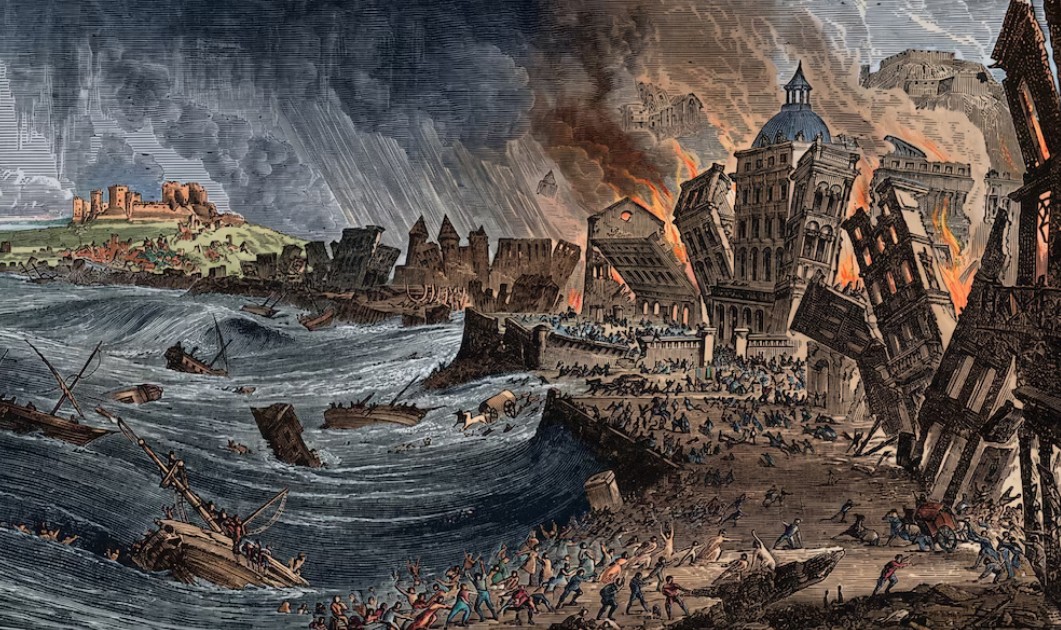
Going back, there was the Lisbon earthquake. This, perhaps the worst earthquake in the history of the Iberian Peninsula, is dated November 1st, 1755 (All Saints Day) and is estimated at 7.7 in strength. The tremor ‘claimed the lives of tens of thousands of people and opened a profound debate among theologians and philosophers about how God could have allowed such a tragedy’ (it was, after all, a religious holiday). In combination with subsequent fires and a tsunami which reached as far as Huelva and Cádiz, the earthquake almost destroyed Lisbon and adjoining areas. Up to 100,000 lives are thought to have been lost on that fateful day.
My own region of Mojácar and Vera was largely destroyed in an earthquake which occurred on the night of November 9th, 1518.
There had been a series of worrisome tremors occurring that year ever since the middle of June, but nothing to match the final convulsion.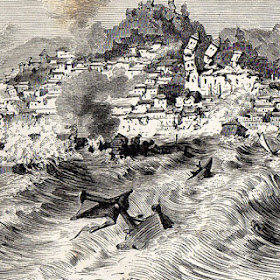
It was a Tuesday, and the earthquake arrived around about midnight. The market-town of Vera was totally destroyed and Mojácar was badly hit. There's an eye-witness account from the then mayor of Mojácar – Iñigo Guevara – who described the collapsed castle in these terms: 'I saw it all fallen in, until the very foundations were visible. There is almost nothing left of the fortress which is so flattened that it appears to have been destroyed by all the artillery of the world'. A report from the time says that almost a third of the eighty homes which made up Mojácar had collapsed. Another report says that the clergy were frightened to give Mass in the church due to its state. It says in the original: "En la dicha villa de Moxacar no se dize misa a causa que los clerigos no osan entrar a dezir misa a la yglesia porque esta para caerse a causa del terremoto que agora hizo”. A little over a dozen people died in Mojácar because of the earthquake. In Vera, the death-toll reached 150.
Just four years later, in 1522, Almería City was almost completely destroyed in another major quake, with at least 2,500 deaths. Those modest numbers, if ‘una terremoto’ of a similar size visited us today, could easily be much higher.
‘We are waiting’, says one newspaper, ‘…for the next major earthquake in Spain: “The clock is ticking and we’re not prepared”. They can’t put a date on it, but some geologists believe we’re in “extra time” for a repeat of an earthquake as destructive as those that shook the peninsula more than a century ago. They also warn that regulations are outdated and fail to consider the worst-case scenario’.
Which reminds me, next week I shall be in Granada, staying with my in-laws. I doubt I’ll get much sleep.