The Costa Blanca and the Costa del Sol together account for more international property purchases than any other region in Spain. Both sit on the Mediterranean, both enjoy more than 300 days of sunshine a year, and both have well-established expat communities, international airports, and a wide range of properties at different price points. The question most buyers arrive at is not which one is better in the abstract, but which one is better for them.
This guide covers the key differences across property prices, cost of living, weather, lifestyle, transport connections, expat communities, and investment potential — and ends with an honest assessment of who each coast is likely to suit best.
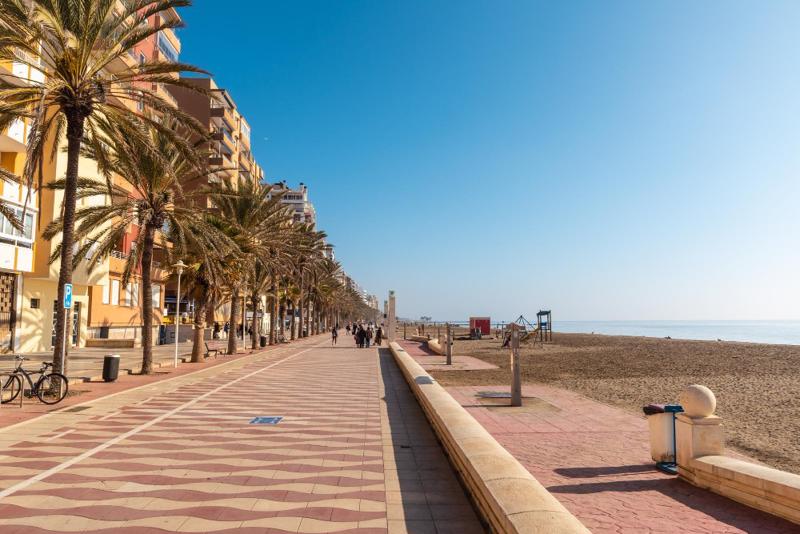 A typical Spanish coastal promenade — the kind of setting that draws international buyers to both the Costa Blanca and the Costa del Sol. Photo: Magnific
Two coasts, two distinct characters
The Costa Blanca stretches for approximately 244 kilometres along the coast of Alicante province (Comunidad Valenciana), from Dénia in the north to Torrevieja in the south. It divides naturally into a quieter, greener northern stretch — around Jávea, Moraira, and Altea — and a more affordable, densely developed southern stretch centred on Torrevieja and Orihuela Costa. Alicante province has the highest foreign buyer share of any Spanish province, at around 51.8% of all purchases, according to data from the Colegio de Registradores (2025).
The Costa del Sol runs for approximately 160 kilometres along the coast of Málaga province (Andalucía), from Nerja in the east to Manilva in the west. Marbella and Puerto Banús define its reputation — glamorous, luxury-oriented, and internationally recognised. Málaga province records a foreign buyer share of around 42.9% of purchases. It is consistently one of the most sought-after coastal markets in Europe, with prices to match.
Both coasts have well-established expat communities, international airports, and a wide choice of properties at different price points — the differences lie in price, character, and the lifestyle each coast delivers. For a broader picture of Spain's full coastline, our guide to the Spanish costas covers all the main areas.
Property prices
The Costa Blanca is consistently 35% to 50% cheaper than the Costa del Sol — the single most significant practical difference between the two coasts. The figures below are drawn from thinkSPAIN listing data and Tinsa's Vivienda en Costa 2025 report, and reflect typical asking prices across each area:
| Property prices by coast — 2025–2026 |
| Property type |
Costa Blanca |
Costa del Sol |
| Average price per m² |
€2,500 – €2,600 |
€3,800 – €4,100 |
| 2-bed apartment (typical) |
€150,000 – €300,000 |
€250,000 – €500,000 |
| Villa with pool |
€350,000 – €800,000 |
€600,000 – €2,000,000 |
| New-build apartment |
€200,000 – €400,000 |
€350,000 – €700,000 |
| Entry threshold (approx.) |
~€100,000 (Torrevieja) |
~€180,000 (Fuengirola) |
| Luxury/premium segment |
€800,000 – €2,000,000 |
€2,000,000 – €10,000,000+ |
Sources: thinkSPAIN listing data; Tinsa Vivienda en Costa 2025. Figures are indicative; prices vary significantly by location and property type within each coast.
Within the Costa Blanca, the northern stretch around Jávea and Moraira commands prices comparable to the western Costa del Sol. The best value is consistently found in the south — Torrevieja, Orihuela Costa, and Guardamar del Segura — where beachside property in Alicante remains among the most affordable on Spain's coast. On the Costa del Sol, Fuengirola and Benalmádena offer the lowest entry points; Marbella and Benahavís the highest.
Both coasts have seen strong price growth. Alicante province recorded 16.4% annual price growth in mid-2025 and Málaga 15.5%, according to INE data. A full breakdown of how these figures compare across all of Spain's regions is available in average property prices by region.
Weather and climate
Both coasts have broadly similar climates by European standards. The differences are real but subtle:
Read more at thinkSPAIN.com