In Gran Canaria there are several old sporting traditions that serve to remind us of a different island to the one we can all experience today. There is no doubt that sport, either as a leisure activity or as one used to provide competitive situations, which communities always seem to require, is an intrinsic part of national traditions all over the world. Remembering the Greek and Roman civilisations, competitive pastimes are some of the most documented activities of the era. For the Greeks there were many opportunities including horse riding events, athletic events of course and also artistic varieties like musical competitions.
 The Greeks and Romans also took part in more aggressive and dangerous sports such as chariot racing, perhaps the latter day equivalent of today's Formula 1 Grand prix races. Knights were famous for jousting and sports like fox hunting have origins in the past. Upon investigation there are very few communities in the world, either today or in the past, that have not engaged in competitive sports as a significant feature of their society. In the modern day, whole nations are defined by their following of a particular sport. In the UK these include football and rugby, while in Belgium they are football and cycling and the USA they are American football and basketball.
Frequently these traditional, national sports are based on skills or abilities required to survive or prosper in days gone by. In countries like the USA the ability to ride a horse was both a means of transport and an essential aid to farming, so it's no surprise that competitive rodeo riding competitions are still held. In seafaring nations like France and Spain, sailing events are still popular.
In the Canary Islands, a part of the world that has seen ownership change many times over the centuries, the sporting history is quite unique. The islands were regularly subjected to various invasions, so fighting games are part of the island's sporting tradition. Sailing is also a favourite sport as the ability to travel by boat between the islands and across the Atlantic to Africa was key.
If you are fortunate enough to spend some time in Tenerife during the month of May you have the chance to witness the Romeria de San Marcos, a traditional celebration of native sports in the town of Tegueste in the north of the island. Here you'll be able to see displays of Lucha Canaria, or Canaria wrestling. Just as you'll see Petanque played on village bouledromes in France, most villages in Tenerife have a local dirt wrestling ring that is used by the clubs on the island. The sport is similar to Greek wrestling and teams from different clubs compete against each other.
Staff fighting is another sport that has been part of Canarian society through the generations. The local name for the game is Juego del Palo. Apparently the ancient Guanche civilizations used the technique as a method of self-defence and the sport is similar in its rules to fencing, where competitors try to touch each other using their sticks without any intent to hurt or injure.
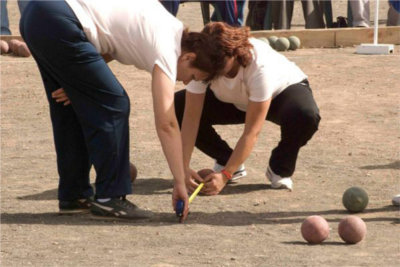
Just as the English have bowls and the French Boules, the islanders of Gran Canaria have their own version called Bola Canaria or Canarian Boules. The game is also a traditional Guanche pastime, when stones were used. Later wooden balls replaced the stones and now resin balls are used today.
One of the most unusual and exciting native sports on Gran Canaria is something, the like of which, you'll be unlikely to see in any other country. The sheep farmers of the Canary Islands must have found a need to quickly descend the mountainsides where they kept their flocks, so they invented a technique using long sticks to speed up progress. Salto del Pastor or Shepherd's Leap sees the competitors vaulting their way down the slopes at amazing speed. They almost appear as if they are out of control and on the verge of disaster. It could be described as a combination of sprinting and pole vaulting and makes for a great spectator sport. The island's authority for the sport hosts an annual competition in late November.
The list of native sports on Gran Canaria doesn't stop there. They also practice the skill of stone lifting or Pulseo de la Piedra, which viewers of the television series to find the world's strongest man will recognise as the Atlas Stones. Another sport which tested strength of the sportsmen of Gran Canaria is that of plough lifting, where contestants are challenged to lift an unwieldy plough in a controlled manner and then rotate a full circle. These types of strength tests resemble the Scottish caber tossing and hammer throwing games and the various types of weight lifting traditions seen around the world.