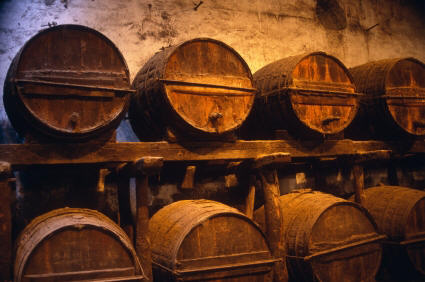
 It was the Phoenicians who introduced Sherry to the Iberian Peninsula, and the Romans were only too happy to carry on the tradition. Even the Moors, who generally abstained from alcohol, used it for medicinal purposes, but when Francis Drake attacked Cadiz in 1587 and returned to England with 3000 barrels, the tipple became an instant favourite with Queen Elizabeth 1 and the English Court, beginning a British love affair with the drink.
In the 17th and 18th centuries the demand for Sherry grew, and many British entrepreneurs based their businesses in the area around Jerez in Andalucia, creating such brands as Garvey and Gordon. In fact the name 'Sherry' comes from the English mispronunciation of the word 'Jerez'; the Northern Europeans finding it difficult to get to grips with the guttural 'j' of the Spanish language. Later in 18th and 19th centuries famous bodegas such as Gonzalez Byass, Domecq, Sandeman and Osborne were founded. There are today, 64 registered bodegas in Jerez, El Puerto de Santa Maria and Sanlucar de Barrameda.
In 1967, the Sherry growers of Jerez won an important legal battle against producers of British Sherry. An Arabic map dating back 1160 proved that the area was then known as 'Seris', and were able to claim rights of denomination of origin, which in effect meant that 'Sherry' could only be produced under that name in their area, but let's face it, they really do know how it's done, and the area is perfect for the job. The chalky soil and humid climate combine to produce the distinctive flavour of true Sherry.
Sherry Vines are always planted in rows that run north to south, to maximise exposure to the Sun. The grape is of the Palomino variety which doesn't actually produce a decent table wine, but is perfect for Sherry. It skin takes on a golden colour when it is ready to harvest in early September. At this time, a festival ensues. The grapes are blessed before being crushed by men in traditional costume. Sherry is actually made from a mixture of vintages, to try to maintain a constant quality. The casks are purposefully not filled o capacity, to allow for oxygenation.
The tradition of exportation continues, with 80% of the produce being exported to countries worldwide, in particularly Britain where the taste for Sherry hasn't diminished. Other strong markets are Holland and Germany.
The main types of Sherry are, Manzanilla, a dry delicate Fino from Sanlucar de Barrameda, Fino, an extremely dry, pale sherry, Amontillado, a nutty flavoured, fuller Sherry, Oloroso with its deep mahogany colour, Cream, a Sherry more popular outside Spain and the ever popular Brandy de Jerez, a rich Brandy matured in old Sherry casks.
The bodegas allow access to visitors during certain hours. Amongst these are Gonzalez Byass, Pedro Domecq, Harveys and Sandemans.
In 1928 an artist named George Massiot Brown approached Sandeman for business. The company asked for designs for posters, and the remarkable silhouette of the Don was born. Dressed like the Spanish caballeros de Jerez in a Portuguese student's cape and wide-brimmed hat, the Don cuts a dark, dramatic figure with his glass of ruby coloured Porto. George Massiot Brown was well aware that French poster artists were very much in vogue, so signed his artwork as G. Massiot to hide his Scottish origins. Little did he know that The Don would be the very first iconic logo for a wine. Recognised throughout the world, The Don represents the mystery and sensuality that communicates the Sandeman brand. The Don continues to prosper. In 1965 Sandeman began advertising on television, featuring the Don, in a series of creative advertisements.
Now, the Sandeman collection is open to the public in a series of themed exhibitions covering the key moments of both the evolution of Porto Wine and of Sandeman, the company and brand. It's well worth a visit if you happen to be in the Jerez area.