How to find reliable relocation services for moving to Spain
Friday, May 29, 2026
Moving to Spain involves considerably more than packing your belongings and booking a flight. Between visa applications, NIE numbers, property searches, bank accounts, school enrolments, and the general complexity of Spanish bureaucracy, the process can feel overwhelming — particularly if you are doing it for the first time from abroad.

Planning your move to Spain: reviewing the paperwork together is an important first step. Photo: Freepik
A relocation service can take much of that weight off your shoulders. But not all relocation companies offer the same thing, and choosing the right one for your situation makes a significant difference to how smoothly the move goes. This guide explains what relocation services actually do, what to look for when comparing providers, and how to find one you can trust.
What does a relocation service do?
The term 'relocation service' covers a wide range of support, from end-to-end move management to specific help with individual tasks. At the broadest level, a full-service relocation company can assist with:
- Visa and immigration applications, including gathering documentation and liaising with consulates
- Obtaining your NIE number — the tax identification number required for almost every official transaction in Spain. For everything you need to know about applying, read our guide to the NIE number in Spain.
- Property searches and rental negotiations, including area orientation and school searches for families with children. For an overview of the Spanish school system, read our guide to education in Spain.
- Registering on the padrón (the municipal population register) and applying for residency
- Opening a Spanish bank account and setting up utilities
- Tax registration and, in some cases, ongoing tax advice
- Shipping and logistics coordination for your belongings
- Cultural orientation and language support
Not every provider offers all of these services, and not every mover needs all of them. The key is identifying which parts of the process you genuinely need help with, and finding a company that covers those areas well.
Do you actually need a relocation company?
A relocation service is not essential for everyone. EU/EEA citizens making a relatively straightforward move — with a job or property already arranged, and some familiarity with Spain — may find they can manage most of the process independently, particularly with the help of good online resources.
That said, a relocation company is worth serious consideration if any of the following apply:
- You are a non-EU/EEA citizen navigating a visa application for the first time
- You are moving with a family and need to coordinate schools, housing, and multiple registrations simultaneously
- You are relocating for work and your employer is covering the costs
- You have a short timeline and cannot afford delays caused by administrative errors
- You do not speak Spanish and are unfamiliar with how Spanish bureaucracy works
- You are buying a property as part of the move and want coordinated support across the legal and administrative process
Even if you plan to handle most things yourself, some people choose to use a relocation company for a specific task only — such as the NIE application or the padrón registration — rather than a full package. Many providers offer this kind of à la carte support. Read more at thinkSPAIN.com
 0
Like
Published at 8:27 PM Comments (0)
0
Like
Published at 8:27 PM Comments (0)
Is investing in property in Spain worth it?
Friday, May 29, 2026
Spain has been one of Europe’s most consistently attractive property markets for international investors for decades. A combination of strong tourism, a growing rental market, competitive entry prices relative to comparable European destinations, and a high quality of life continues to draw buyers from across the world.
But ‘Spain’ is not one market — it is many. And ‘investing’ means different things to different people. Whether you are looking for rental income, long-term capital growth, or a property that does both, the factors that determine whether an investment makes sense are the same: the right location, a clear understanding of the costs and regulations involved, and a realistic view of the returns.
 Spain's Mediterranean coastline remains one of the most sought-after destinations for international property investors. Photo: Magnific
This guide covers the key considerations for anyone thinking about investing in Spanish property — what the market looks like right now, what drives returns, what to factor into your decision, and what to be aware of before you commit.
The Spanish property market in 2026: what investors need to know
Spain's property market has performed strongly over the past three years, and 2026 continues that trend. According to the INE House Price Index, prices grew by approximately 12.7% year-on-year in Q2 2025 — the highest rate in 18 years — with the national average reaching approximately €2,200 per square metre. Forecasts from BBVA Research and CaixaBank Research point to continued growth in 2026 at a more moderate pace of around 5–6% — a normalisation rather than a slowdown, and still well above historical norms.
The structural driver is straightforward: demand consistently outpaces supply. The Banco de España estimates a cumulative housing shortfall in high-demand areas, with new housing completions well below the pace needed to meet demand. This imbalance supports both property values and rental prices — for existing contracts, INE data puts rental inflation at 2.5% in February 2026, tracking close to overall inflation levels. For a current breakdown of prices across all 17 regions, our average property prices by region guide gives the full picture.
Foreign buyers remain a significant presence. According to Global Property Guide, international purchases accounted for around 14% of all transactions in the first half of 2025, and Spain's real estate investment sector closed 2025 with over €18.4 billion in transactions — a 31% jump from the previous year.
What returns can you expect from Spanish property?
Returns on Spanish property investment come from two sources: rental income (yield) and capital appreciation. The balance between the two depends heavily on where you buy and what strategy you pursue.
Rental yields
The average gross rental yield in Spain stood at 5.45% in Q1 2026, according to Global Property Guide data. This figure varies considerably by location — Barcelona delivered the highest yield among major cities at 7.40%, while Palma de Mallorca came in at 4.41% at the lower end. Murcia, one of the most affordable coastal markets, offers yields of around 6% or above in coastal areas, reflecting its combination of lower purchase prices and solid rental demand.
Read more at thinkSPAIN.com
1
Like
Published at 8:17 PM Comments (0)
Do I need a lawyer when buying property in Spain?
Friday, May 22, 2026
Spanish law does not require you to hire a lawyer when buying property. You could, in theory, complete a purchase using only a notary. In practice, however, the vast majority of experienced buyers — and every property professional we are aware of — would advise strongly against it. The risks of proceeding without legal representation in Spain are significant, and the cost of a lawyer is modest relative to the value of the transaction.
This guide explains exactly what a property lawyer does in Spain, what they typically cost, and why their role is so different from that of the notary.

Your lawyer reviews and signs documents on your behalf at every stage of the purchase process. Photo: Magnific
Why do you need a lawyer when buying property in Spain?
The notary's role in a Spanish property transaction is limited to authenticating the final deed. They verify the identity of both parties, confirm the legal standing of the property at the point of signing, and authorise the escritura pública (public deed). What they do not do is protect your interests, investigate the property's history, check for hidden debts or illegal constructions, or advise you on the terms of any contract before you sign it.
A property lawyer — an abogado specialising in real estate — fills that gap entirely. They act solely on your behalf from the moment you identify a property to the point at which you receive your registered title deed. In a legal system where the buyer carries most of the risk, that independent representation is not a luxury.
This is particularly valuable for international buyers who are not based in Spain. Your lawyer can supervise every step of the process on your behalf — reviewing contracts, carrying out due diligence, and if needed, completing the purchase under power of attorney without you needing to be physically present in Spain at any stage. For many foreign buyers, having someone they trust on the ground is the single most compelling reason to instruct a lawyer early.
The notary is a public official whose role is to authenticate the transaction — not to advise the buyer. Engaging your own lawyer is the only way to ensure someone with legal expertise is working exclusively in your interest.
What does a property lawyer do in Spain?
A good property lawyer covers every legal aspect of the purchase from the moment you make an offer to several weeks after completion. Their work typically includes:
Due diligence on the property
Before you commit to anything, your lawyer checks the Registro de la Propiedad (Land Registry) to confirm the seller’s ownership and identify any charges, mortgages, debts, or liens registered against the property. They also verify that the property’s built area matches what is registered, that there are no illegal extensions or planning violations, and that all building licences are in order. This is the single most important thing a lawyer does — and it is something neither the notary nor the estate agent will do on your behalf.
Read more at thinkSPAIN.com
1
Like
Published at 10:52 PM Comments (1)
Moving to Spain: What it's really like to live in Spain as an expat
Friday, May 22, 2026
Spain, with its sun-drenched beaches, fiestas, and relaxed lifestyle, is often romanticised as an idyllic paradise. It’s no surprise that millions of tourists flock here annually, and many eventually decide to make it their home. However, for those who take the leap from being a visitor to becoming a resident, the realities of living in Spain often contrast sharply with the image formed during short holidays. Below, we delve into the many facets of life in Spain, exposing the nuances that foreigners experience and and showcasing the opportunities available for those willing to adapt and plan.
 Barcelona: A city that captivates tourists and residents alike, offering a unique blend of urban energy, rich culture, and coastal beauty. Photo: Freepik
Housing: rentals vs. permanent living
During holidays, staying in a charming Airbnb or seaside resort can give the impression that housing in Spain is easy and affordable.
However, as a resident, the experience is often more complex. Rental prices in cities such as Barcelona, Madrid, and Valencia have soared due to high demand and competition. A modest two-bedroom apartment in central Barcelona, for example, can cost over €1,200 per month. Unlike a holiday booking, securing a rental as a resident requires extensive documentation, including proof of income, work contracts, and deposits. While this process involves preparation, it offers you a valuable opportunity to better understand the local market and find a home that truly suits your lifestyle.
If you’re willing to look outside major city centres or explore up-and-coming neighbourhoods, you’ll find excellent value for money compared to other parts of Europe. Small towns and rural areas offer affordable rentals and stunning natural surroundings. Additionally, Spain’s relaxed lifestyle and lower property prices make buying property a realistic goal for many expats.
Buying property in Spain might initially seem appealing because of comparatively lower prices. However, buying costs, including taxes, legal fees, and ongoing maintenance, can quickly add up. For guidance on the things to consider when buying a property in Spain, understanding the step-by-step process for foreign buyers, or navigating average house prices compared to other countries, careful research is essential.
Careful research and professional advice can help you navigate these challenges. With thorough preparation, buying property in Spain can be a rewarding long-term investment, offering both stability and a chance to integrate fully into Spanish life.
Work and employment realities
Tourists visiting Spain often see bustling markets, lively restaurants, and thriving cultural events, assuming job opportunities are plentiful. While the job market can be competitive, there are still many opportunities for expats willing to adapt.
Unemployment rates in Spain are among the highest in Europe, particularly for young people. Expats who are just starting out may find roles teaching English, freelancing remotely, or working in international companies as excellent stepping stones. Spain’s growing economy and increasing opportunities for remote work mean that expats can carve out fulfilling careers. Teaching English remains a reliable entry point, while remote work allows professionals to enjoy Spain’s lifestyle without being tied to local employment markets.
Learning Spanish, gaining qualifications in in-demand sectors, and exploring freelance or entrepreneurial opportunities can greatly improve your prospects. Many expats successfully transition to stable careers by leveraging their unique skills and international experience. Additionally, Spain’s digital nomad visas offer a smooth path for remote workers seeking to live and work in this vibrant country.
Securing a job may also involve navigating Spain’s bureaucratic processes. However, with proper preparation and guidance—such as understanding the requirements for obtaining work permits, Social Security numbers, and residency—many expats find the process manageable. For advice on securing your first job in Spain or identifying the top jobs for expats, preparation is key.
Cost of living: more than meets the eye
During holidays, the cost of living in Spain might seem extraordinarily low. A glass of wine for €2 and a plate of tapas for €4 appear to promise a life of affordable indulgence. However, you’ll find that day-to-day expenses paint a more nuanced picture. Heating in winter and air conditioning in summer can drive up bills.
Read more at thinkSPAIN.com
2
Like
Published at 10:48 PM Comments (2)
Average property prices by region in Spain 2026
Saturday, May 16, 2026
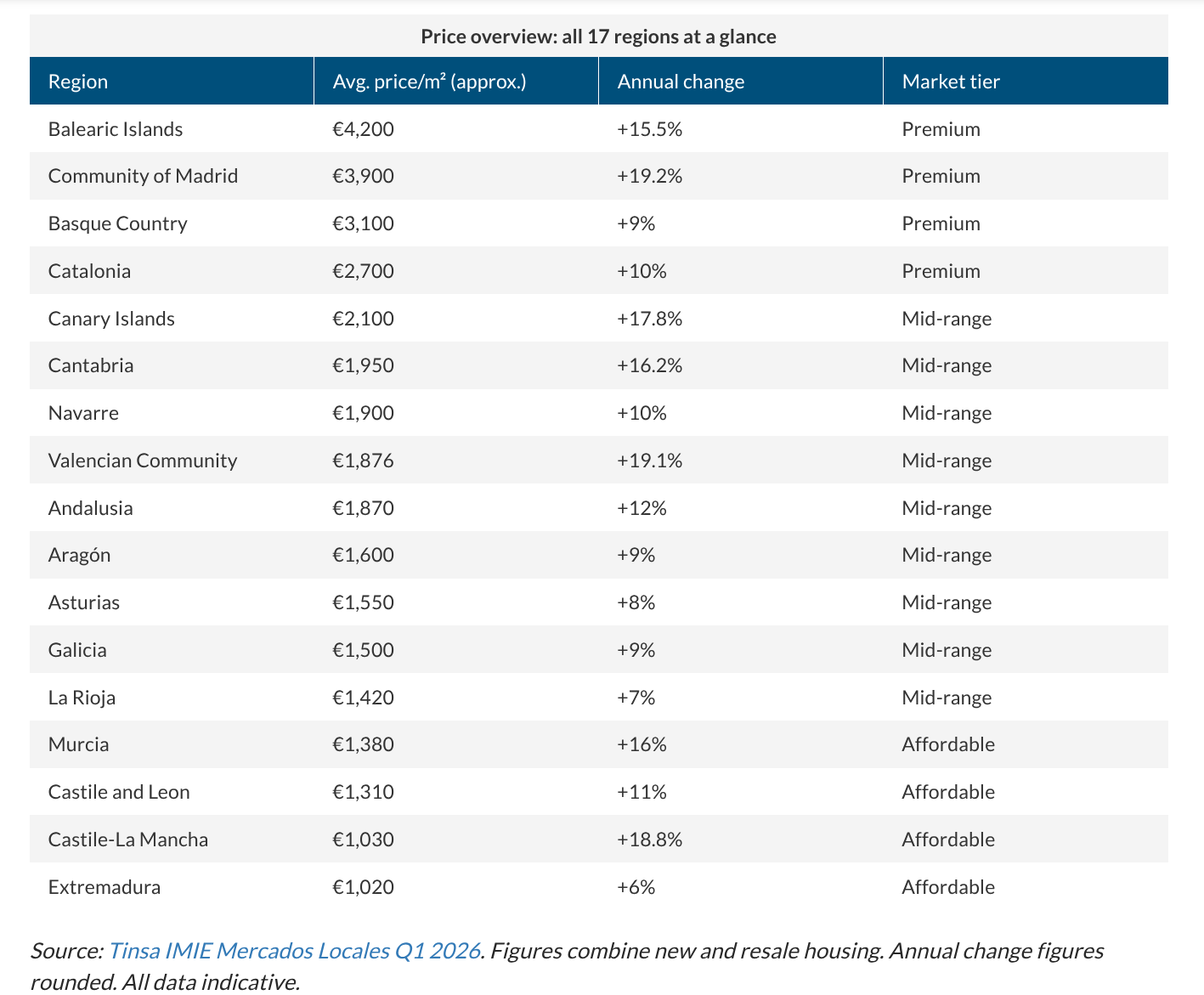
Spain's property market entered 2026 with prices rising at their fastest pace in nearly two decades. The national average for new and resale housing reached €1,987 per square metre in Q1 2026, representing a 14.3% year-on-year increase and 11.8% growth in real terms after adjusting for inflation. To put that in practical terms: at the national average, a 90m² apartment costs approximately €179,000. But that figure is almost meaningless in isolation, because Spain is not one property market — it is seventeen very different ones.
The difference between the most and least expensive regions is stark. The Balearic Islands sit at more than four times the price per square metre of Extremadura. Understanding the regional picture is the essential starting point for any buyer comparing locations. All figures in this article are drawn from Tinsa's IMIE Mercados Locales index and reflect Q1 2026 data covering new and resale housing combined. They should be treated as indicative — prices within any region can differ substantially depending on location, property type, and condition. Where city-level figures are quoted separately, these refer to resale market data and will differ from the broader regional average.
 Barcelona is one of Spain's most active property markets, with prices well above the national average. Photo: Freepik
It is also worth keeping in mind that the purchase price is only part of the budget. Taxes, notary fees, land registry costs, and legal fees typically add 10 to 14% on top of the agreed price — our guide to buying property in Spain covers those costs in full.
Premium markets
Balearic Islands — approx. €4,200/m²
The Balearic Islands are the only Spanish region to have fully recovered and matched the peak values of the 2007 boom in real, inflation-adjusted terms. Ibiza and Formentera sit at the very top of the price range; Mallorca covers a broad spread from luxury coastal villas to more accessible inland towns; Menorca offers the most moderate entry point of the four islands.
At the regional average, a 90m² apartment costs around €378,000, though prime coastal locations will take that considerably higher. Supply is structurally constrained across all islands, and short-term rental licensing restrictions have added further pressure on the purchase market. If the islands are on your shortlist, see what is currently available in the Balearics.
 Clifftop properties in Mallorca represent some of the highest price per square metre in Spain. Photo: Freepik
The Community of Madrid recorded the highest year-on-year growth of any region in Q1 2026, at 19.2%. The capital itself averages around €5,162 per square metre for resale properties, though the spread within the city is substantial — prime central districts approach €10,000 per square metre, while more accessible outer areas remain under €3,000. Madrid is one of the most liquid and transparent property markets in the country, with strong rental demand and excellent connectivity. Browse properties for sale in Madrid to get a sense of what the market looks like right now.
Basque Country — approx. €3,100/m²
The Basque Country is the third most expensive region in Spain, with San Sebastián holding the title of most expensive provincial capital in the country — a position driven by chronic supply shortage in an already densely built coastal city. Bilbao offers a more accessible entry point and has undergone significant urban regeneration over the past two decades. Unlike the southern coastal markets, this region draws predominantly domestic buyers rather than international ones, which gives the market a different character and more stable, less seasonal demand.
Read more at thinkSPAIN.com
1
Like
Published at 12:06 AM Comments (0)
Best places in Barcelona for buying a home
Saturday, May 16, 2026
The Barcelona property market has entered a phase of mature, stable growth following the record-breaking surges of 2024 and 2025. Barcelona is a city defined by its physical limits—wedged between the Collserola mountains and the Mediterranean Sea. This geographical "ceiling" has created a market driven primarily by scarcity. For the international buyer, it is no longer about finding a bargain, but about securing high-value assets in a global hub that remains significantly more affordable than London, Paris, or New York, yet offers a Mediterranean lifestyle that is second to none.

Barcelona's iconic grid system is home to the neighbourhood of Eixample. Photo: Unsplash
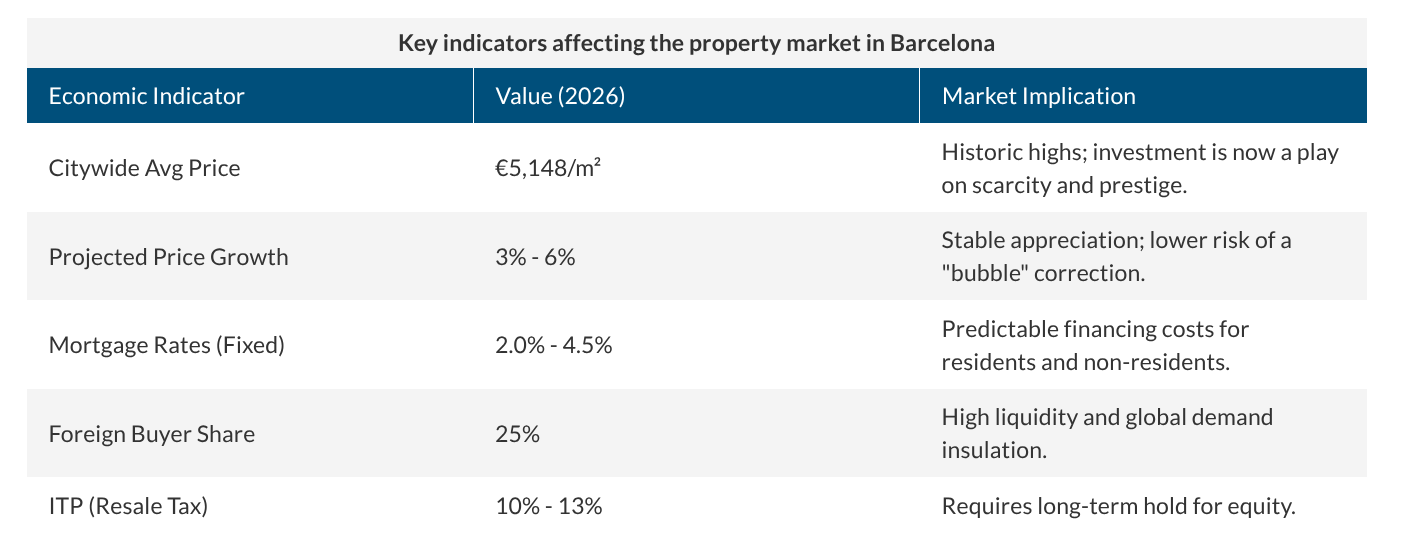
The year 2025 closed with Barcelona reaching a new historic high, with average prices across the capital of Catalonia standing at approximately €5,148 per square metre. While the double-digit appreciation of previous years has moderated, experts from major banks like BBVA and CaixaBank project a steady 3% to 6% growth for 2026. This stabilisation is welcomed by long-term investors, signalling a healthy market where demand continues to outpace supply. For those looking to buy, the window of opportunity is characterised by more predictable mortgage conditions, with the 12-month Euribor stabilising around 2.72%, making financing more accessible than in the volatile early 2020s.
Foreign interest remains the bedrock of the market, accounting for 25% of all transactions in the province—the highest figure on record. The demographic has evolved; while the French, British, and Germans remain active, 2026 is seeing a surge in North American buyers and Asian communities, particularly in the premium and luxury segments. Whether you are seeking a seaside home in Sitges or a modernist masterpiece in Eixample, understanding the distinct "micro-markets" of the Barcelona region is essential for a successful purchase.
The economic indicators for 2026 in Barcelona
Barcelona’s economy continues to outperform the Eurozone average, fueled by a thriving tech ecosystem and a resilient tourism sector that expects nearly 100 million visitors nationwide this year.
Where do most expats live in Barcelona?
Barcelona’s international community is as diverse as it is expansive, with more than 20,000 expats calling the Eixample district home. Ultimately, the 'best' neighbourhood for you depends on your specific professional requirements and lifestyle priorities. Let's explore Barcelona to see which area or neighbourhood might best suit your needs:
Eixample: The professional epicentre
The aerial photo of Barcelona’s iconic grid layout above represents the neighbourhood of Eixample. This is the heart of the city and the primary choice for young professionals and digital nomads. The area surrounding the Sagrada Familia offers a more residential and quieter pace than the core of Eixample.
- Property type: Grand 19th-century buildings with high ceilings, ornate "hydraulic" tile floors, and wrought-iron balconies. Many residents live in beautiful period flats that often feature direct views of Gaudí’s masterpiece, making it a "trophy" location for many international buyers. Buying near the Sagrada Familia ensures your asset is always in demand.
- Prices: Average prices sit around €6,363/m².
- Lifestyle: High walkability, world-class dining, and the iconic "Superblocks" (Superilles), which have reduced traffic and added green spaces.
Gràcia: The village in the city
Ask any long-term expat where the "soul" of the city lies, and they will likely point to Gràcia. Once an independent village, it retains a fiercely local identity and a bohemian atmosphere.
Read more at thinkSPAIN.com
1
Like
Published at 12:03 AM Comments (0)
Essential tips to boost energy efficiency in your Spanish home
Friday, May 8, 2026
For homeowners in Spain, improving energy efficiency is more than just a cost-saving measure—it's a long-term investment in comfort, sustainability, and property value. With the country’s wide-ranging climate conditions, from the warm Mediterranean coast to the cooler northern and inland regions, making your home more energy efficient can have immediate and lasting benefits. By reducing energy consumption, you can lower your utility bills, minimise your environmental footprint, and increase the overall comfort of your home.
This guide outlines the key reasons why energy efficiency should be a priority and offers practical steps to improve your property’s performance. Additionally, we explore some of the latest innovations and financial incentives that make energy efficiency upgrades even more appealing for Spanish homeowners.

Installing solar panels help reduce energy costs and increase property value by utilising the abundant sunlight in Spain. Photo: Freepik
Why is improving energy efficiency in your Spanish home important?
Improving energy efficiency in your home goes beyond saving money on bills—it's about maximizing comfort, sustainability, and the effectiveness of every energy unit used. An energy-efficient property maintains ideal living conditions, like temperature and lighting, without unnecessary waste. This means lower utility costs, increased comfort, and a reduced environmental footprint, all while optimizing the performance of your home’s systems, appliances, and structural elements (such as insulation and windows).
Energy efficiency plays a critical role in managing living expenses, maintaining a comfortable environment, and contributing to sustainability goals. Here are some of the key reasons why homeowners in Spain should prioritise energy efficiency:
- Lower utility costs: Energy prices in Spain are among the highest in Europe, which makes energy efficiency upgrades particularly valuable. Homes that use less energy for heating, cooling, and other functions see significantly lower monthly bills. For example, in regions with hot summers, where air conditioning is essential, energy-efficient homes can cut electricity bills by 20% or more.
- Increased comfort: An energy-efficient home not only helps maintain consistent temperatures but also provides better indoor air quality. Proper insulation, efficient windows, and well-maintained systems prevent uncomfortable drafts and hot or cold spots, creating a more pleasant living environment year-round.
- Environmental benefits: With a growing global focus on sustainability, improving your home’s energy efficiency is an effective way to reduce your carbon footprint. Spain’s renewable energy goals, such as achieving 42% of energy from renewables by 2030, mean that homeowners can contribute directly to national efforts by making their properties more sustainable.
- Higher property value: Energy-efficient homes are increasingly in demand among property buyers in Spain. Features such as solar panels, advanced insulation, and modern heating systems can add significant value to a home. For those looking to sell or rent out their property, these upgrades make the home more attractive to prospective buyers or tenants who prioritize sustainability and lower operating costs.
- Avoiding costly repairs: Additionally, regular maintenance and upgrades to improve energy efficiency not only enhance comfort but can prevent larger, more expensive repairs. Homes with well-maintained heating systems and proper insulation last longer and require less frequent repairs. Addressing inefficiencies now can save homeowners from costly breakdowns later.
How to improve energy efficiency in your Spanish home
Now, let’s explore practical strategies for improving energy efficiency. These detailed, actionable tips will help boost the energy performance of your Spanish property, maximising comfort while minimising unnecessary energy costs.
1. Start with an energy audit
An energy audit provides a clear overview of your home’s current efficiency and highlights areas where upgrades will be most impactful. In Spain, local authorities and private companies offer professional energy audits that evaluate your home’s:
- Insulation in walls, ceilings, and floors
- Heating and cooling system performance
- Window and door sealing for air leakage
- Appliance and lighting efficiency
- Potential for integrating renewable energy, such as solar power
2. Insulate key areas of your home
Proper insulation is essential to improving energy efficiency in any home. Many Spanish homes, especially older ones, lack sufficient insulation, which leads to higher energy consumption for heating and cooling. Spain’s varied climate, ranging from hot summers in the south to cooler winters in the north, makes insulation a key factor for energy conservation.
When considering insulation, focus on the following areas:
Read more at thinkSPAIN.com
0
Like
Published at 3:36 PM Comments (0)
Spain becomes Europe's top destination for real estate investment
Friday, May 8, 2026
Spain has become Europe’s top destination for real estate investment in the CBRE European Investor Intentions Survey 2026, overtaking the United Kingdom, Germany and France. The survey, based on responses from nearly 700 investors, places Spain first in Europe for cross-border property capital.
 Madrid ranks second among Europe's most attractive cities for real estate investment in 2026. Photo: Pexels
The result marks the culmination of a five-year rise. Spain did not appear in the ranking in 2021, entered in seventh place in 2022, rose to fourth in 2024, climbed to second in 2025 and now takes the top position.
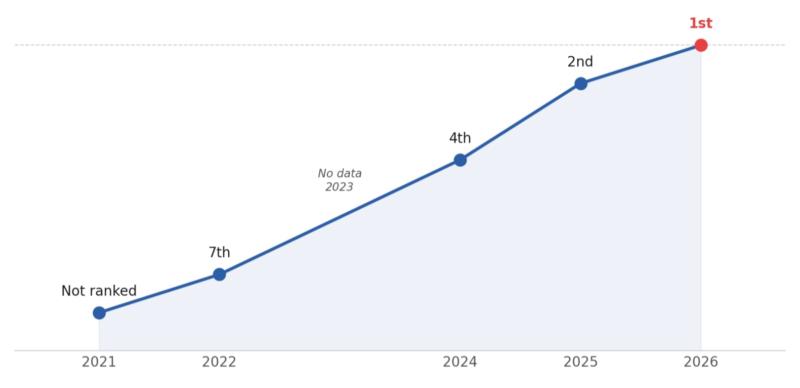 Spain’s ranking among Europe’s most attractive real estate investment destinations, 2021–2026. Source: CBRE European Investor Intentions Survey 2026.
Key findings
The survey highlights several trends shaping investor sentiment across the European property market.
- Spain ranked first among European countries for expected real estate returns in 2026, named by just under half of cross-border investors
- Madrid holds second place among Europe's most attractive cities for investment, retaining its position for the second consecutive year
- Barcelona ranks fourth — making Spain the only country with two cities in the top five, alongside London (1st), Warsaw (3rd) and Milan (5th)
- 89% of surveyed investors expect purchasing activity to increase or remain stable in 2026
- 83% expect sales activity to increase or remain steady, signalling improving alignment between buyers and sellers on pricing
- The residential sector remains the most preferred asset class for the second consecutive year, accounting for 34% of responses
Total real estate investment in Spain reached €18.4 billion in 2025, representing a 31% year-on-year increase and the highest volume since 2018, exceeding the European average growth rate. Madrid and Barcelona together accounted for 58% of the total investment volume, reflecting strong demand from institutional investors as well as high-spending property buyers.
Read more at thinkSPAIN.com
1
Like
Published at 3:34 PM Comments (0)
Property taxes in Spain vs Germany: key differences explained
Friday, May 1, 2026
If you are considering buying a property in Spain, understanding how the tax system compares to Germany is one of the most practical steps you can take. Some taxes work in a similar way in both countries; others are structured quite differently, and knowing where the key differences lie will help you plan your budget with confidence.
This article covers the main taxes you will encounter as a property owner in Spain — when buying, when selling, on an ongoing annual basis, and on inheritance — with a clear comparison to the equivalent German rules at each stage.

Understanding the tax obligations involved in buying property in Spain is an important step for any international buyer. Photo: Freepik
Taxes when buying a property
In Germany, the main purchase tax is the Grunderwerbsteuer, which varies by federal state — from 3.5% in Bavaria to 6.5% in states such as North Rhine-Westphalia, Brandenburg, and Schleswig-Holstein. Notary and land registry fees add a further 1.5% to 2%. Since 2020, estate agent fees are split equally between buyer and seller by law.
In Spain, what you pay depends on whether the property is new or second-hand — a distinction that does not exist in the same way in Germany:
- For a resale property, you pay ITP (Impuesto sobre Transmisiones Patrimoniales), Spain's equivalent of the Grunderwerbsteuer. Rates range from 6% in Madrid to 7% in Andalucía and 7.75% in Murcia. Cataluña applies a progressive scale: 10% up to €600,000, 11% from €600,001 to €900,000, 12% from €900,001 to €1,500,000, and 13% above that — making it one of the most expensive regions for resale purchases. The Valencian Community applies 10% as its standard rate, though this is set to reduce to 9% for properties under €1 million from June 2026.
- For a new-build property, ITP does not apply; instead you pay IVA (VAT) at 10% of the purchase price, plus AJD (stamp duty) of between 0.5% and 1.5% depending on the region. Unlike Germany, agent fees in Spain are typically paid by the seller, though buyers should always confirm this in their purchase agreement.
Total purchase costs in Spain — including notary and land registry fees — typically add 10% to 13% on top of the purchase price for resale properties, and 12% to 15% for new builds. Our guide to taxes when buying a property in Spain covers each of these in full detail.
| Taxes & Costs |
Germany |
Spain |
| Purchase tax (resale) |
Grunderwerbsteuer 3.5%–6.5% by state |
ITP 6%–13% by region |
| Purchase tax (new build) |
Grunderwerbsteuer 3.5%–6.5% |
IVA 10% + AJD (stamp duty) 0.5%–1.5% |
| Notary and registry |
~1.5%–2% |
~1%–2% |
| Agent fees |
Split equally between buyer and seller by law |
Typically paid by the seller |
Property purchase taxes and costs: Germany vs Spain
A worked example: €300,000 purchase
To make the comparison concrete, consider a €300,000 property purchase.
Resale property:
- Bavaria (resale): Grunderwerbsteuer at 3.5% = €10,500, plus notary and registry fees of approximately €5,000. Total additional costs: approximately €15,500, or around 5.2% of the purchase price.
- Andalucía (resale): ITP at 7% = €21,000, plus notary and registry fees of approximately €3,500. Total additional costs: approximately €24,500, or around 8.2% of the purchase price.
New build:
- Bavaria (new build): The same Grunderwerbsteuer of 3.5% applies = €10,500, plus notary and registry fees of approximately €5,000. Unlike Spain, Germany does not apply VAT to residential new-build purchases by private buyers. Total additional costs: approximately €15,500, or around 5.2% of the purchase price — identical to a resale purchase.
- Spain (new build): IVA at 10% = €30,000, plus AJD at 1.2% = €3,600, plus notary and registry fees of approximately €3,500. Total additional costs: approximately €37,100, or around 12.4% of the purchase price.
The comparison illustrates two important points. First, in Germany the tax cost of buying is the same whether the property is new or second-hand — the Grunderwerbsteuer applies equally to both. In Spain, the new-build route carries a significantly higher upfront tax burden, which is one of the most important distinctions for German buyers to understand. Second, even a resale purchase in Andalucía costs notably more in tax than the equivalent purchase in Bavaria, though the gap is manageable with careful budgeting.
Annual property taxes
In Germany, the annual Grundsteuer is a local levy calculated using the assessed property value, a federal rate, and a local municipal multiplier. Following the 2025 reform, values have been updated to reflect current market levels. In practice, annual amounts are very low — almost symbolic in many cases — with a typical Berlin apartment generating a bill of around €80 to €150 per year.
In Spain, the equivalent is IBI (Impuesto sobre Bienes Inmuebles), also a municipal tax based on the cadastral value of the property rather than the market value. IBI rates typically range from 0.4% to 1.1% of the cadastral value. Bills are broadly comparable in many cases, though Spain shows greater variation and can be noticeably higher in prime locations such as Marbella or Ibiza. Full details on how IBI is calculated and when it falls due are in our guide to IBI property tax in Spain.
One important difference for non-resident owners is Spain's imputed income tax on unrented properties, filed via Modelo 210. If you own a property in Spain and do not rent it out, you are still required to pay a modest annual tax calculated on a percentage of the cadastral value. Germany has no equivalent to this obligation, and it catches many foreign buyers by surprise.
Taxes when selling a property
Both countries tax capital gains on property, but the rules differ in important ways:
Read more at thinkSPAIN.com
2
Like
Published at 3:49 PM Comments (0)
Spam post or Abuse? Please let us know
|
|