When most British expats and travellers think of Cantabria, they picture rolling emerald pastures, wild Atlantic surf, and plates of fresh rabas enjoyed beside a rugged northern harbour. Yet hidden beneath the serene limestone peaks of this lush northern region lies a geological monster that few people outside the elite caving world have ever heard of.
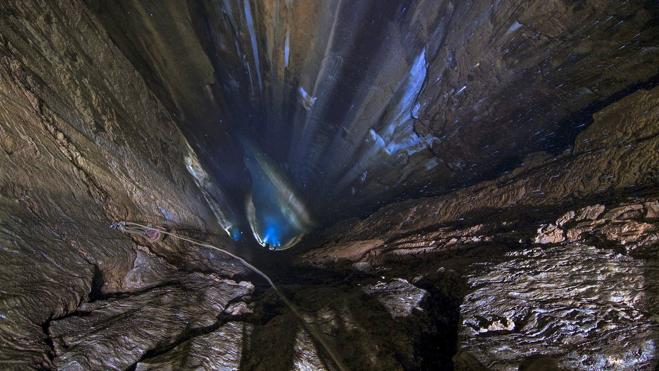
Tucked away near the quiet municipality of Ruesga, the Gran Pozo MTDE—also known locally as the Torca del Porrón—is a sheer, uninterrupted vertical shaft plunging an astonishing 435 metres straight down into the earth. Taller than the Eiffel Tower and significantly deeper than the height of London’s Shard, it is not only the deepest natural pit in Spain, but the second-deepest vertical free-fall drop in the entire world.
A Whisper of Wind in the Rocks: The 2016 Discovery
What makes the Gran Pozo MTDE even more remarkable is how recently it was found. In the summer of 2016, a team of speleologists from the Espeleo Club Ábrigu and the Club Cántabro de Exploraciones Subterráneas were surveying the rugged mountain terrain around Ruesga.
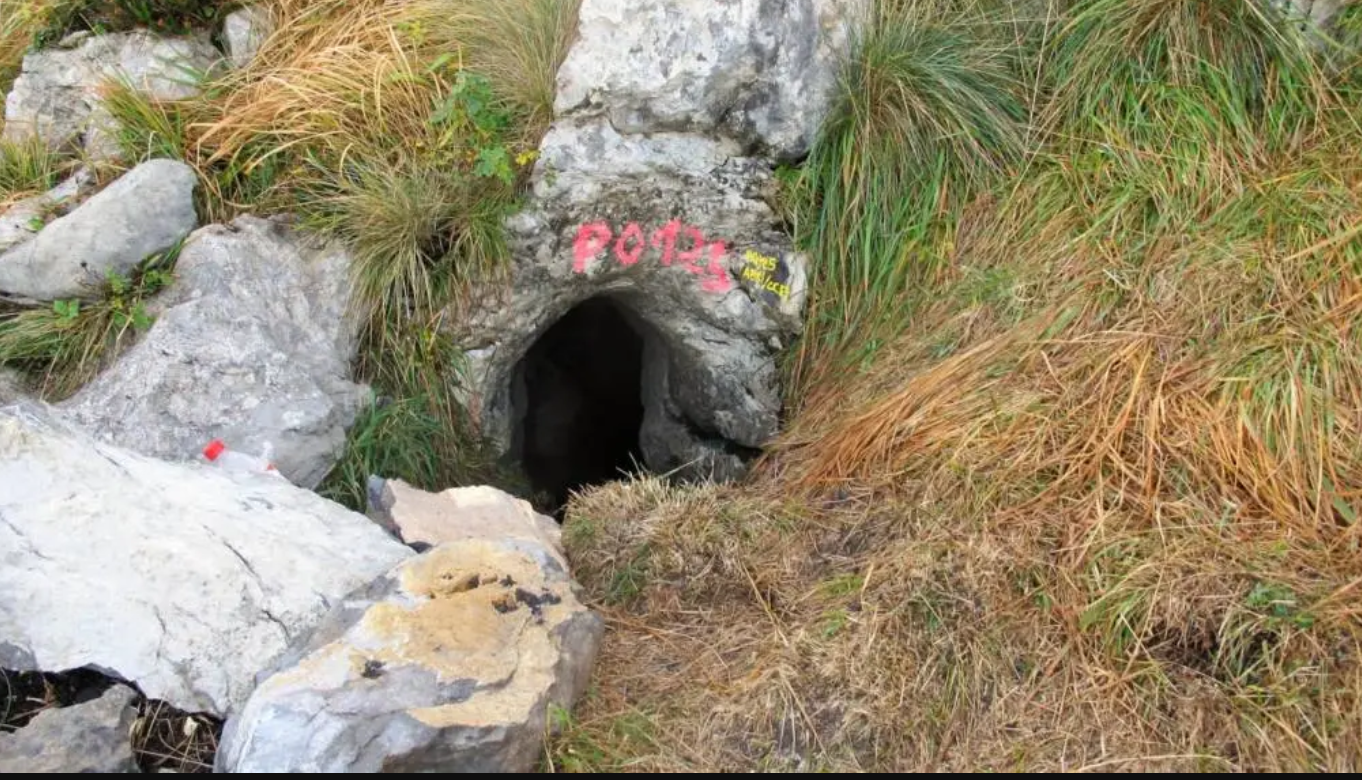
As caver Sergio Ruiz later recounted, the team stumbled upon nothing more than a narrow fissure between the rocks. What stopped them in their tracks was a powerful, unmistakable current of air rushing out of the crack—a classic sign of a massive hidden void below. Knowing the surrounding mountains were already honeycombed with large caves, they decided to investigate. After several days of painstaking exploration, they broke through to the rim of an underground abyss that defied all expectations.
A Vertical Giant
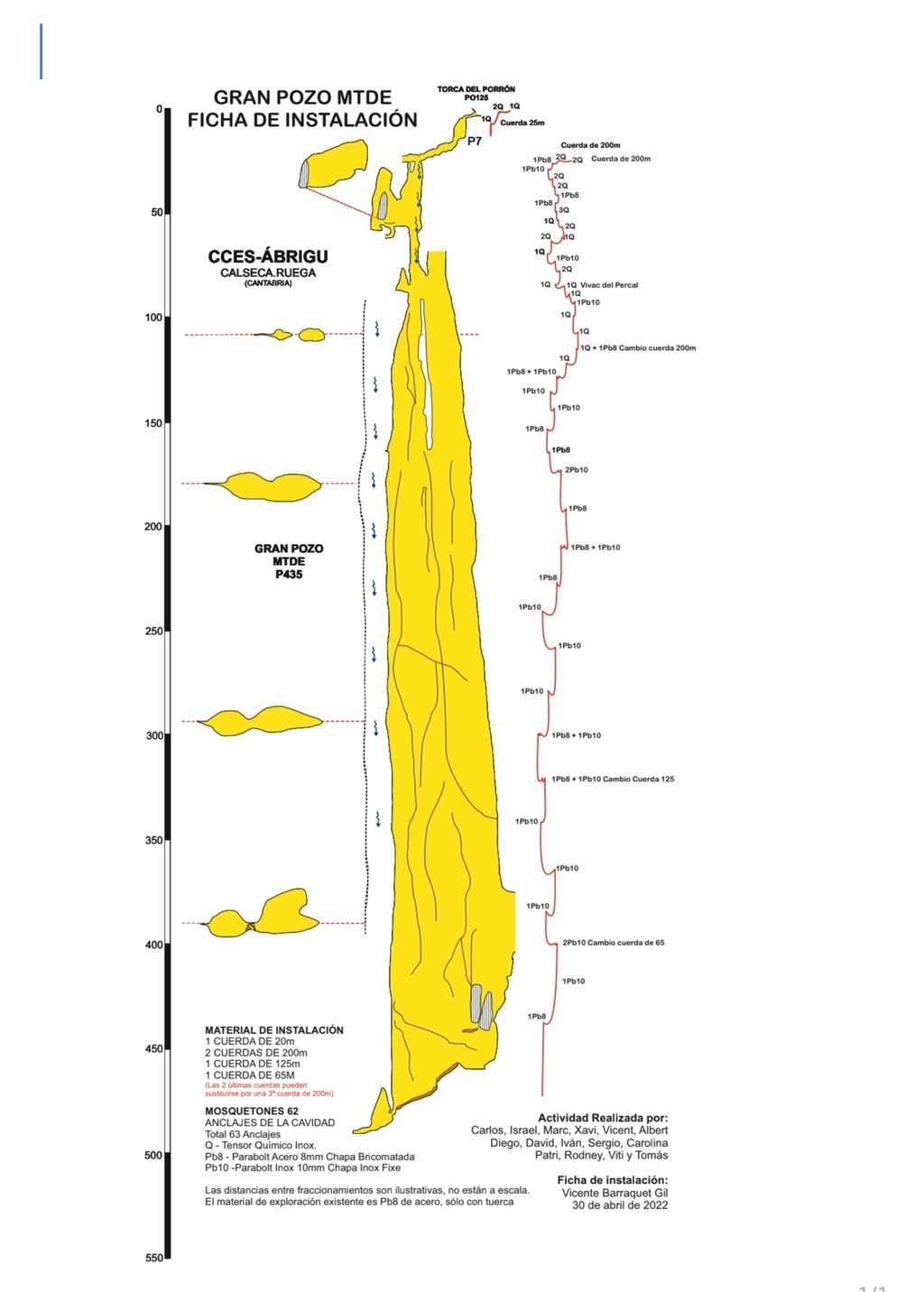
To appreciate the sheer scale of the Torca del Porrón, it helps to distinguish between a stepped cave shaft and a pure vertical drop. The Gran Pozo MTDE is a single, unbroken 435-metre free-fall with no ledges or resting platforms along the way.
Navigating it is a feat reserved strictly for the world’s most seasoned underground athletes. After dropping through an initial seven-metre entry shaft, cavers face a gruelling descent that takes at least an hour and a half on ropes—followed by an exhausting three-hour vertical climb back to daylight. At the very bottom lies an eerie cavern known as the Sala Maldita (the Cursed Chamber), which connects into the wider Torca del Tejón cave system.
Hidden Life in the Darkness
Subterranean worlds cut off from sunlight for millennia often evolve along completely separate biological paths from the surface above. As researchers predicted, the dark, damp microclimate of the Asón valley’s deep caves has proved to be a treasure trove for biologists.
Five years after the shaft’s discovery, the Club Cántabro de Exploraciones Subterráneas contributed to a scientific study documenting a rare, relict invertebrate endemic to the Asón area: the Cantabrodesmus lorioli, a specialised species of cave-dwelling millipede adapted entirely to life in the subterranean dark.
Can You Visit the Gran Pozo MTDE?
If you are tempted to add this natural wonder to your next northern Spain road trip, you will have to admire the landscape from above ground.
-
Closed to the General Public: Turning the Torca del Porrón into a tourist attraction has been firmly ruled out. Doing so would be economically unviable, would cause irreversible damage to the fragile mountain environment, and—in the words of local caving experts—would be "dangerous in every sense."
-
Open to Elite Cavers: While no special permits are currently required for specialised speleology teams wishing to tackle the shaft, local clubs stress that enthusiasm alone is not enough. Attempting the Gran Pozo MTDE requires technical skill, equipment, and physical conditioning equivalent to scaling high-altitude alpine peaks.
Cantabria’s Karst Paradise: A Swiss Cheese of Mountains
The Gran Pozo MTDE is far from an isolated freak of nature. It sits inside the Porracolina karst massif, part of the eastern Cantabrian Mountain Range encompassing the Collados del Asón Natural Park, Castro Valnera, and the Sierra de Hornijo.
Millions of years of rainwater dissolving thick layers of limestone—interlaced with bands of sandstone and impermeable rock—have turned this corner of northern Spain into a global Mecca for underground explorers. Within the very same mountain range lie several other staggering vertical drops, including Pozo Negro (340 metres), Pozo del Buldo (314 metres), and Pozo Juhue (302 metres).
You do not need a harness and climbing ropes to enjoy Cantabria’s extraordinary underground heritage. If you are visiting the region, drive through the breathtaking Collados del Asón Natural Park for dramatic mountain waterfalls and sweeping limestone valleys—and then head west to Cueva El Soplao (often called the "Sistine Chapel of Geology"), a fully accessible, family-friendly show cave packed with rare crystal formations.
Beneath its sunny beaches and historic cities, Spain hides some of the most dramatic wild landscapes in Europe—even hundreds of metres underground.
Have you ever explored the dramatic limestone valleys of Cantabria or visited any of Spain’s famous caves like El Soplao or Nerja? Would you ever be brave enough to abseil 435 metres into the pitch black, or do you prefer keeping your feet firmly on dry land?