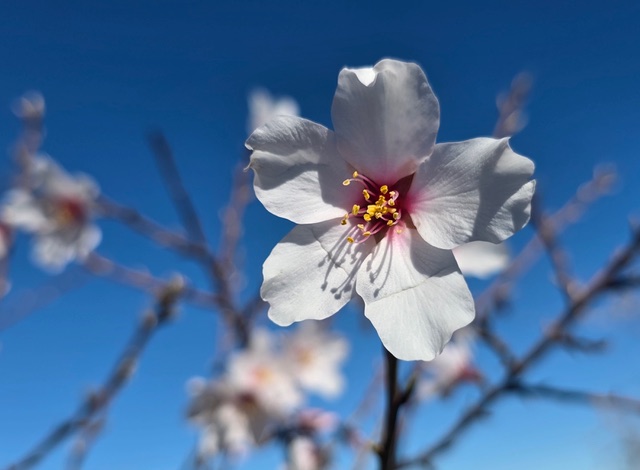
Prunus dulcis. Photo © Karethe Linaae
Of all the early signs of Andalusian spring, the almond blossom is my absolute favourite. The tree, which has grown in this region for millennia, is one of the first to bloom in the new year. Depending on the location, this can happen as early as January or as late as March. This year, torrential rains from late November to early February delayed the seasonal changes. I was concerned that the storms would have stripped all the buds from the trees, but fortunately, I needn’t have worried. These days, the Serranía de Ronda has burst into bloom.
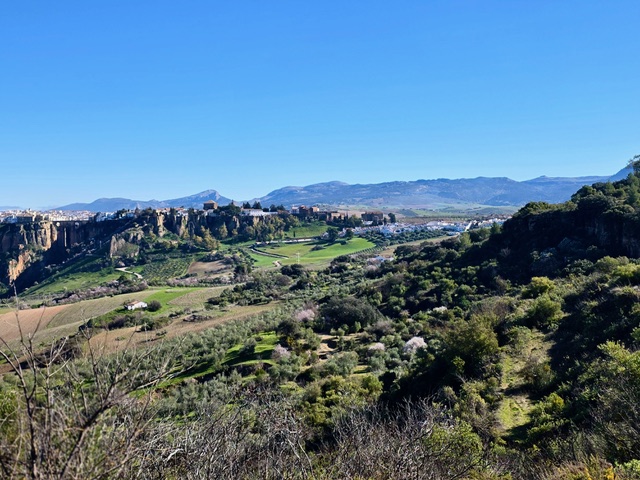
Mid-February, with almond trees blooming. Photo © Karethe Linaae
To witness these initial signs of spring, one must not linger, or they might be gone. There is always the threat that frosty nights will destroy the delicate flowers. Yet it is precisely this fleeting quality that makes them so precious to behold. The season creates a sudden longing to embrace nature’s rebirth — a burst of ‘spring fever,’ an irresistible urge to rush outdoors.
Not wanting to take any chances, I set off, camera in hand. A shortcut, a few blocks and a roundabout away, I find myself heading towards Virgen de la Cabeza along a rustic country road, flanked by freely growing olive groves. Walking through these fields is my sanity check and daily refuge. It is always a peaceful, sensory experience — particularly today, when the air carries a faint, sweet promise and the humming of bees signals that life is about to reawaken. And this is where my hunt for the ultimate almond blossoms begins.
Pastel landscape
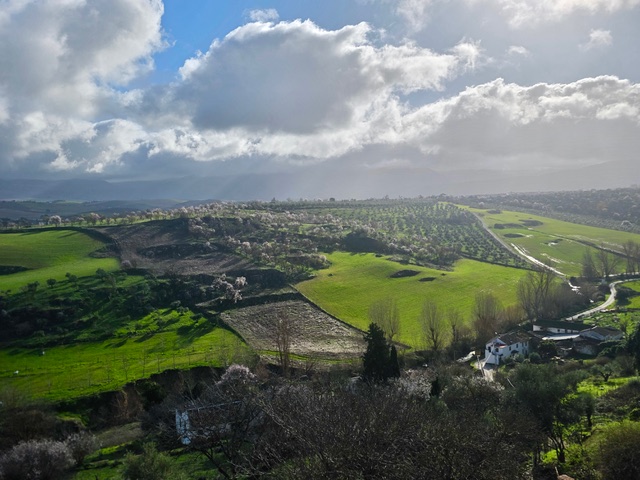
Verdant expanse broken by pastel patches. Photo © Karethe Linaae
Winter in Andalucía can be almost iridescent green, but when I look out over the valley, the verdant expanse is broken by pastel patches. Months before the intoxicating scent of orange blossom fills every Andalusian street and plaza in May, our Sierra hosts an unassuming, yet spectacular unveiling. Almond blossoms announce spring, painting the landscape in soft shades of virgin white, blush and pink. The arrival marks the profound transformation about to unfold, which is why the blooms in many cultures have become symbols of rebirth.
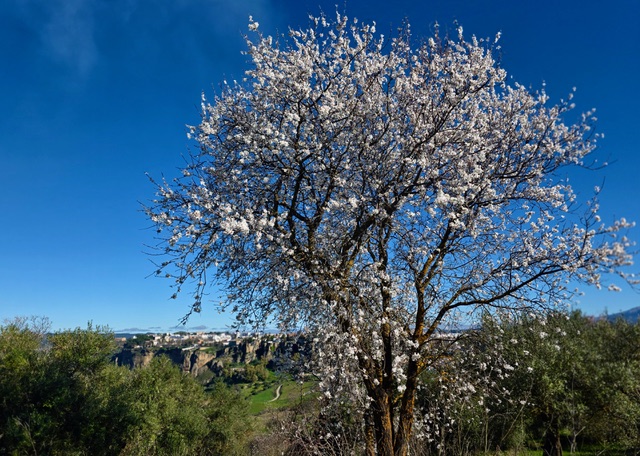
Almond tree with Ronda in the background. Photo © Karethe Linaae
After a short walk, I spot an early bloomer silhouetted against Ronda’s impressive cliff-lined cityscape. This particular specimen has grown tall and unruly, its rugged trunk contrasting with a plethora of fluttering petals. In fact, these flowers appear along the branches even before the leaves have begun to sprout.
Sweet and white
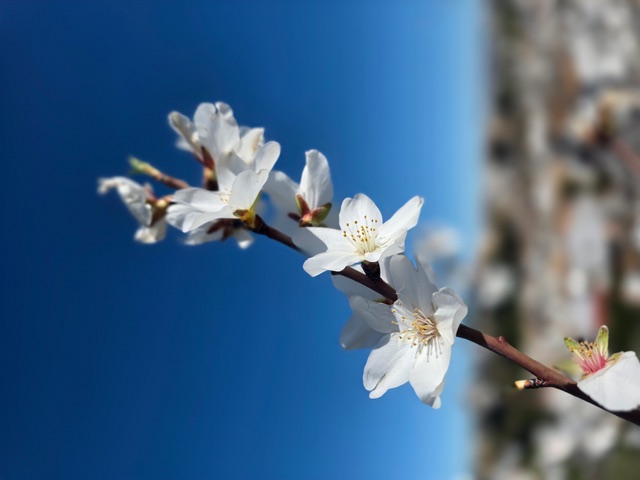
Branch of sweet almond blossom. Photo © Karethe Linaae
The sweet almond tree (Prunus dulcis) produces the common almonds seen in large almond farms. The pale buds open into snowy white, porcelain or ever-so-slightly pink flowers, with yellow or dark crimson centres.
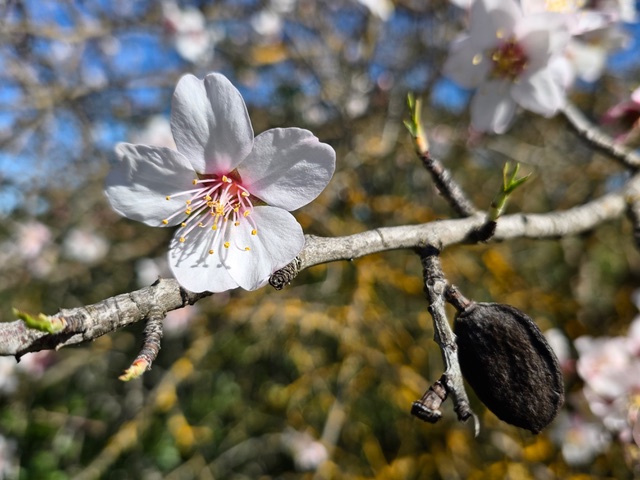
Almond blossom and last year’s fruit. Photo © Karethe Linaae
Like the frail beauty of the flowers and the mild taste of the fruit, the scent is neither overpowering nor immediate. They are nothing like orange blossoms, whose fragrance from a single tree can overpower an entire city block, although the olfactory properties are said to be related.
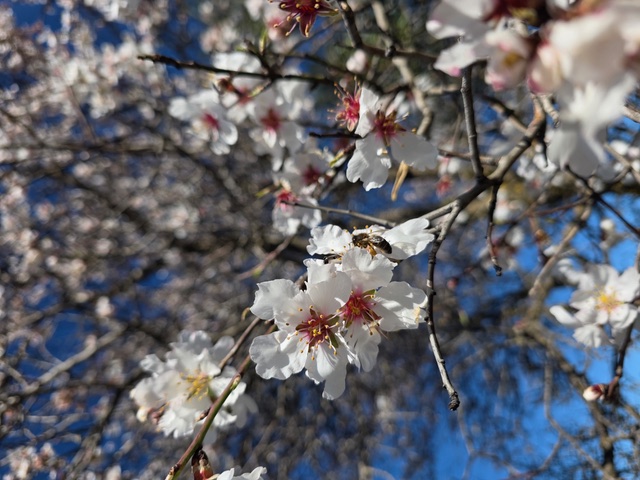
Fluttering blossoms. Photo © Karethe Linaae
The scent of sweet almond blossoms is light as air. Its subtle sweetness echoes my late grandmother’s flower garden. It is sometimes described as powdery, and whoever said that must have smelled her baking. The floral tones evoke a distant memory of a white picket fence lined with flowering sweet peas. There is also a whisper of honey, perhaps Mexican vanilla, and nutty undertones reminiscent of marzipan. It is a muted yet authentic scent from a time when nothing had been artificially enhanced in colour or flavour.
A biblical meeting
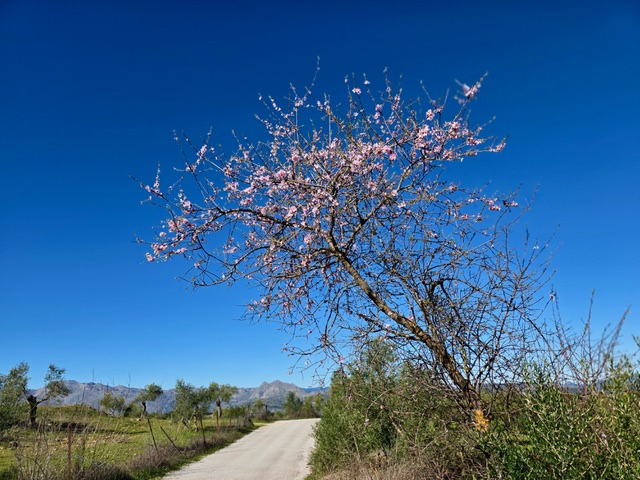
Blue sky. Photo © Karethe Linaae
As I walk on, I pass several other almond trees on the hillside and the occasional twig with a couple of pink blooms growing by the road. Still, I continue my search for a worthy specimen of the less common bitter almond tree.
It is easy to see how these blooms have inspired writers, painters and mystics alike. According to folk legends, almond branches were once used to uncover hidden treasures.
Although Van Gogh’s favourite flowers were sunflowers, he painted Almond Blossoms in Saint-Rémy-de-Provence in 1890 as a gift to his brother Theo in celebration of his newborn son. The motif — almond blossom branches against a deep blue sky — was inspired by classic Japanese sakura prints.
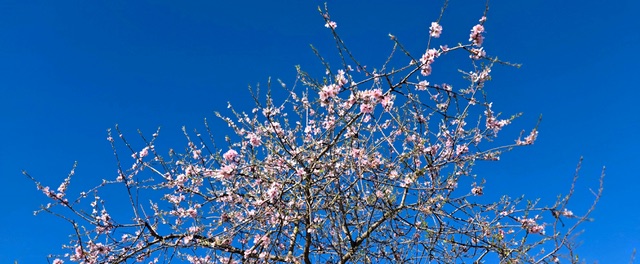
Against the blue sky. Photo © Karethe Linaae
I have read that almond blossoms are mentioned several times in the Bible, and that St. Francis — the very saint after whom our San Francisco neighbourhood is named — also praised these blooms.
As if providence had eavesdropped on my thoughts, a priest I recognise from celebrations at our local convent appears on the same road, striding with quiet purpose. Not wanting to let the opportunity pass, I ask the Padre — with measured restraint (after all, I am a sworn heathen…) — whether the Flor de Almendra appears in the Bible. He affirms, adding a few words about spring and renewal, but does not elaborate further. I leave him to his solitary peace, imagining that he may reserve his most intimate words for his Maker along this meditative dirt path.
An inedible ‘scent-sation’
Allowing serendipity to guide me, I notice a narrow road splintering off into the brush. Though I have walked this path countless times, I have never ventured down this particular offshoot. Granted, a chain blocks the entrance, yet one can easily slip around it. I prefer to think it is meant to deter motor vehicles, not innocent strollers in pursuit of pink blossoms.
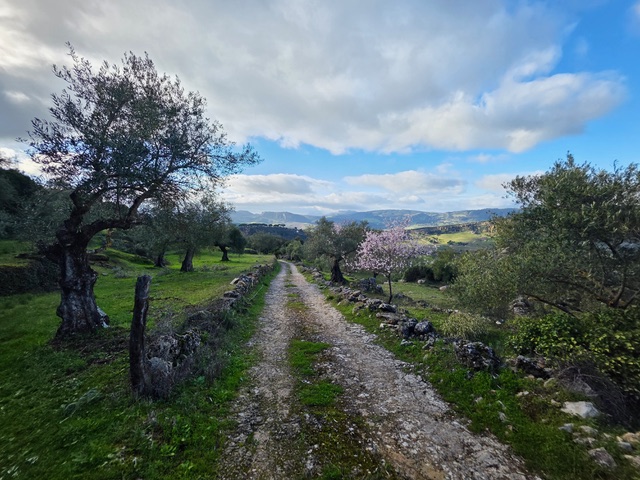
A magical landscape. Photo © Karethe Linaae
After following the road around a forested bend, the most picturesque Andalusian landscape unfolds before me. The medieval-looking track, lined with moss-covered stones, disappears into the distance. On either side, gnarled olive trees and rugged boulders mingle with the occasional almond tree, dotted across the sunlit fields. Among them, I find my next specimen.
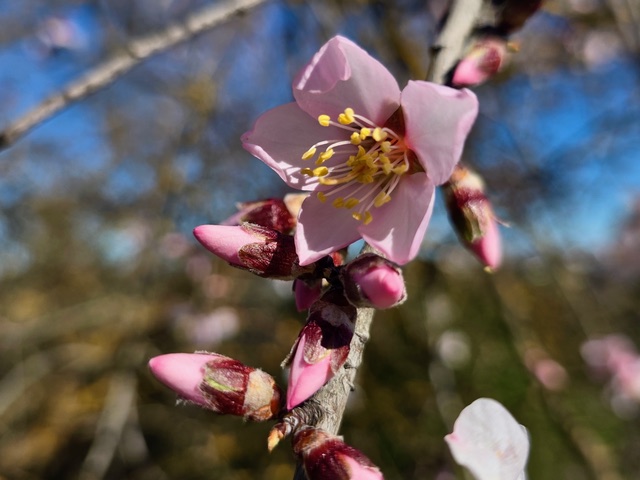
Prunus amygdalus var. amara. Photo © Karethe Linaae
The bitter almond tree (Prunus amygdalus var. amara) now grows mostly wild, as few choose to cultivate its fruit. The tree produces striking light-to-bright pink and fuchsia blossoms with deep magenta or reddish-white centres. The blossoms carry a richer, more intoxicating scent than their sweet counterparts. Yet since the trees grow wild in our midst, each seems to possess its own distinct fragrance and hues.
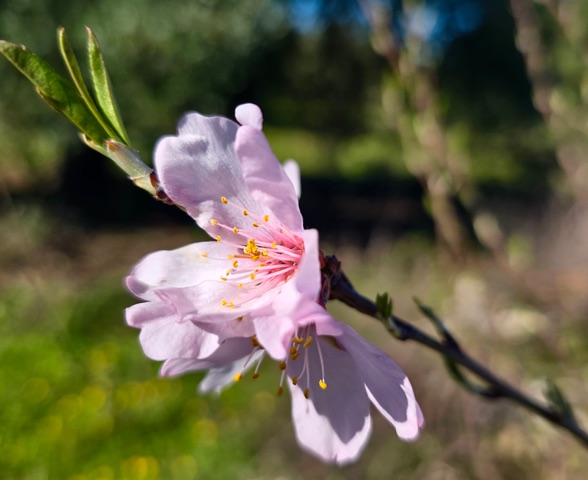
Pale pink. Photo © Karethe Linaae
The fruit contains high levels of amygdalin, a compound that releases cyanide when ingested. For this reason, bitter almonds are considered inedible, although their essence is widely used in baking after processing. I must admit that when I happen to stumble upon a bitter nut in a batch, I eat it with mischievous delight, convinced that, in a world filled with environmental toxins, the occasional bitter almond is unlikely to be my undoing.
My final advice for this spring blossom expedition is simple: resist the temptation to pluck a branch. You will be disappointed to return home and find the petals already fallen. Almond blossoms cannot be gathered; they do not endure. Perhaps that is their quiet lesson. Natural beauty is not meant to be possessed — only witnessed.
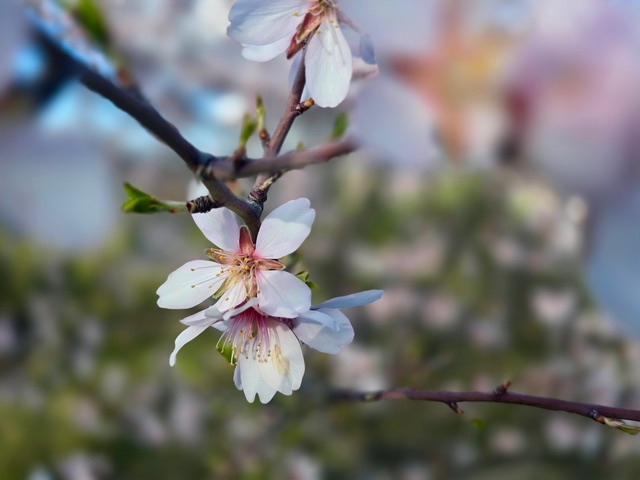
Spring branch. Photo © Karethe Linaae