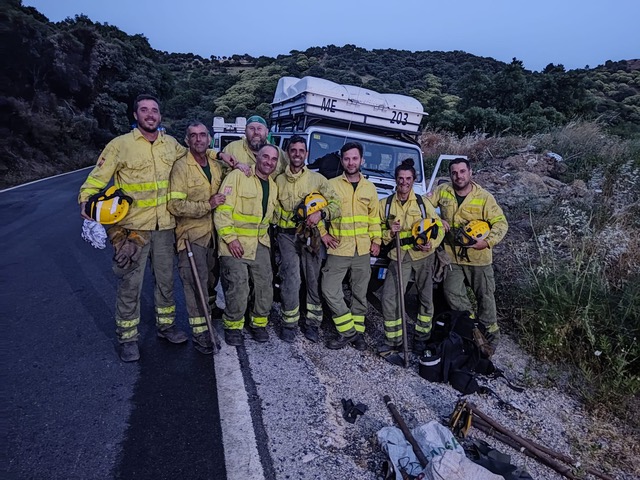
Forest fire unit with Isa as only female member. Photo © Isa Moreno-INFOCA
Climate change is causing increasingly extreme meteorological phenomena, including heatwaves, intense storms, and prolonged droughts. These are things that we who reside in Andalucía must learn to live with, but there is one consequence of climate change that may threaten people and the natural environment more than anything else.
In recent years, the frequency and spread of forest fires have increased significantly. Canada's almost uncontainable fires have brought airborne ash all the way to Europe, but forest fires at home have also become more difficult to control. I met an admirable couple who work for the Andalusian Forest Fire Service in western Málaga. Isabel María Moreno Jiménez (52) and José del Río González (54), known as Isa and Pepe among friends, fight and prevent forest fires and other natural disasters – she as the agency's emergency manager and he as the technical manager for fire operations. I joined them at work and learned about the emergency plan and the many challenges that today's forest firefighters face.

Forest firefighters Isabel María Moreno Jiménez and José del Río González. Photo © Karethe Linaae
The historic Sierra Bermeja fire
Wednesday, September 8, 2021. It's almost 10 p.m., and Isa and Pepe have just sat down to eat dinner when the alarm goes off about a wildfire in the Sierra Bermeja near Estepona. Within a few minutes, both are on their way, fully equipped with firefighting gear, Pepe in the Infoca jeep on radio contact with the provincial operations centre in Málaga and Isa with her unit. As they approach the scene of the fire, a sea of flames can be seen against the night sky.
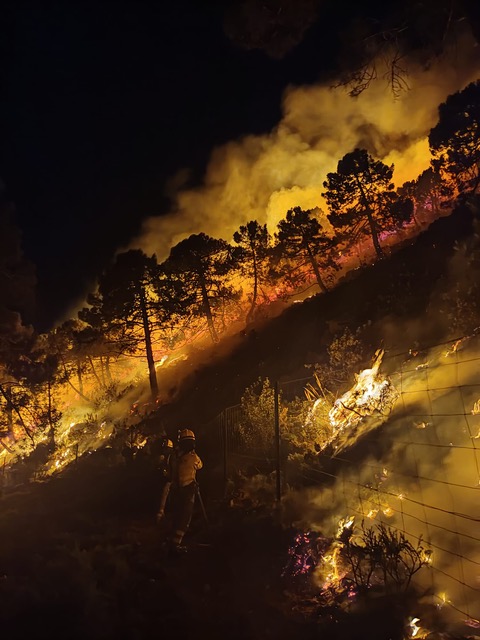
“At night, when we can’t fly, the firefighting work is done with the help of ground crews with fire hoses and powerful all-terrain vehicles that can manoeuvre in steep terrain.” Photo © Isa Moreno/INFOCA
No one knew at the time that this fire would destroy 8,401 hectares of forest and take the life of a firefighter, making it one of the worst fires in the history of the Málaga province. Despite a crew of several thousand working around the clock, the flames spread to seven municipalities in the province – Estepona, Casares, Jubrique, Genalguacil, Júzcar, Faraján and Benahavís – where 2,670 people were evacuated. The fire raged for six days before it was declared "under control", but work continued for a full 46 days before the forest fire was officially extinguished.
What is PLAN INFOCA
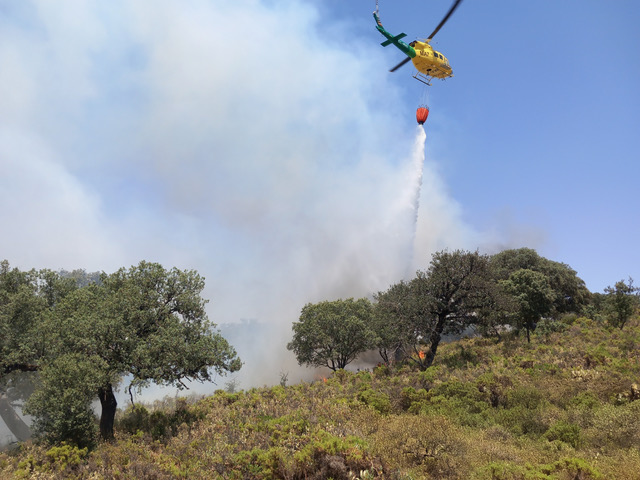
Forest fire operation with a helicopter. Photo © Isa Moreno/INFOCA
Andalusia's regional forest fire management plan, Plan Infoca, has been in operation since 1985 and includes measures and systems that prevent and extinguish forest fires and restore affected areas.
In 2025, the plan has mobilised the largest unit in the region’s history with a budget of €257 million, 43.2% to extinguishing work and 56.8% to prevention. To guarantee maximum coverage and rapid response, this includes over 4,700 professionals, a regional operations centre, eight provincial operations centres, 23 forest defence centres, ten sub-centres, three specialised brigade bases, 186 guardhouses, 40 aircraft, 28 helipads, eleven airstrips, 1,011 vehicles, 119 forest fire engines and 2,200 open water tanks.
From midwife to firefighter

Forest firefighters Isabel María Moreno Jiménez and José del Río González. Photo © Karethe Linaae
Neither Isa nor Pepe planned to work in firefighting, but chance brought them together, and since then, the rescue service has been their second home.
“I wanted to be a technical draftsman when I was young,” Pepe admits. “But after terminating my studies and working for a year, I missed being outside in nature. I’ve always liked hiking in the mountains, so instead of continuing with architecture, I decided to become a forestry engineer and took a course to change my field of study.”
“My family has always worked in forestry and agriculture, but my childhood dream was to become a midwife, Isa recalls. “I needed points to get into the program and had to take some extra courses, and that’s where I met Pepe. I changed my plans and started studying forestry engineering, because it covers a wide range of topics and allows you to work with many different things.”
After graduating, both applied to Infoca in their hometown of Ronda. However, since they lacked work experience, they ended up working for two years as firefighters in Toledo and one year at a helicopter base before finally getting a job at the Forest Defence Centre (CEDEFO) in Ronda in 2004.
Isa started as a fire specialist, but a few months later, she got pregnant.
“Both of us couldn't continue working in this field with small children, so I left it until the children were older. In 2019, Infoca needed staff and contacted me. I passed the tests, got a couple of longer vacancies and was offered a permanent job last autumn. In my current position, I am responsible for the rural monitoring huts in our area and the logistics during emergencies. At the same time, I oversee fire studies where we take samples of vegetation to measure humidity and determine the flammability of a specific area.”
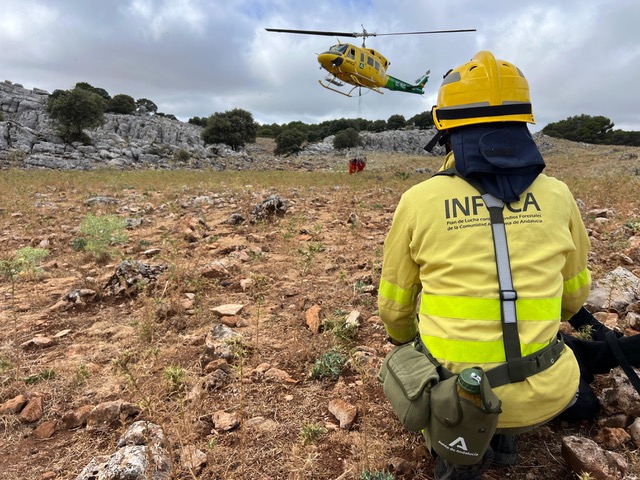
Isa at work. Photo © Isa Moreno/INFOCA
Pepe is one of three operations technicians responsible for the forest fire unit in Ronda, leading the extinguishing work in western Málaga. They work in continuous shifts where one has time off, one is on 24-hour duty, and one is ready by the helicopter in case of an emergency call.
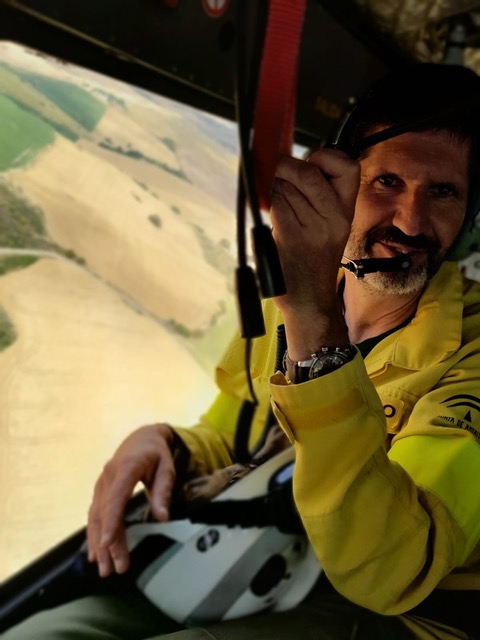
Pepe in the helicopter. Photo © Isa Moreno/INFOCA
“When a fire breaks out in our area, my job as a technical officer is to decide which resources need to be allocated to each emergency. If the fire spreads and we must call in units from other areas, the operations centre in Málaga takes over. The helicopter drops me and my team off at the fire so I can assess the situation. At the same time, we have a technical officer in the air who decides where to drop water. The work is a joint effort – the ground crew can't do anything without water, and the air resources need the teams on the ground to work the terrain and put out the flames.”
Not a job for everyone
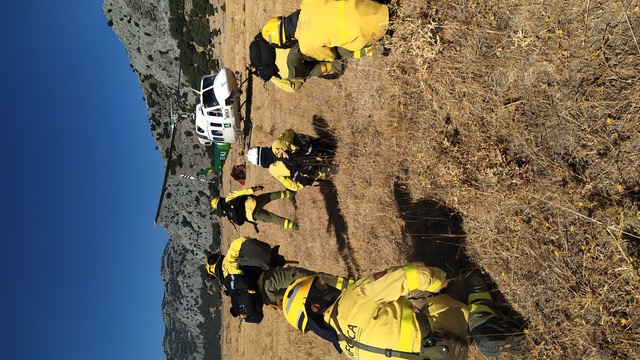
Back to the helicopter. Photo © Isa Moreno/INFOCA
Most firefighters have a background in agriculture or forestry. However, the vital thing, according to Isa and Pepe, is that they understand the seriousness of the job, are strong both physically and mentally, and are not intimidated.
Isa is not anxious at work, but can understand that some people become overwhelmed when they face a forest fire for the first time. “A colleague was completely paralysed with fear during the Sierra Bermeja fire. He had worked in the forest fire service for a couple of years but had probably never experienced anything like it”, she recalls.
Pepe is never afraid, whether in the air or on the ground
“What worries me is the responsibility I have for the units. Infoca's safety apparatus works very well, but no one can control nature. The ground crews generally only work on the flanks and on the leeward side of the fire, but what if the wind suddenly changes, surrounding the unit with flames?” he wonders.

“I understand that people want to help, but specialists are needed to put out forest fires.” Photo © Isa Moreno/INFOCA
Working in the forest fire service is not for everyone. Few women enter the profession, and Isa is still the only female firefighter at the Ronda operations centre. But things are changing. The city now has a higher education program for rescue services, and more young people wish to work in the rescue unit and do their internship with Infoca.
When there was a fire in the past, the fire brigade would go out to the Andalusian villages and bring people to work, but today, special education, training and entrance exams are required.
“We are the only emergency service where the requirements are the same for men and women, which includes physical and psychotechnical tests”, Isa points out.
Permanent employees are evaluated annually, and if they fail the requirements, they get a warning. Under normal circumstances, more senior employees are eventually transferred to less physically demanding positions, such as watchmen or drivers.
Infoca’s work does not only pertain to forest fires anymore. Last year, the Andalusian Agency for Security and Comprehensive Crisis Management, EMA, was established. This includes all the structures for civil protection in emergencies and covers all types of natural disasters and emergencies, such as floods and search and rescue. Infoca was therefore active during the Valencia flood disaster of 2024 and sent weekly convoys to the affected areas.
A day on the Infoca base
Infoca’s operations centre in Ronda is located in a guarded area outside the city and is one of the largest and most well-equipped centres in Andalusia.
“Each Andalusian province has two or three forest protection centres, depending on the size of the forest. Málaga has two, one in Ronda and one in Colmenar, northeast of Málaga city”, Pepe says.
The centre in Ronda covers over 30 municipalities from the Serranía de Ronda to the Costa del Sol. They have access to 21 units, each containing a crew of seven professionals, in addition to vehicles and equipment. The centre has people on call 24 hours a day, and when a fire is reported, the units must be inside the helicopter within ten minutes. Infoca can also send us to forest fires outside the region or even abroad.
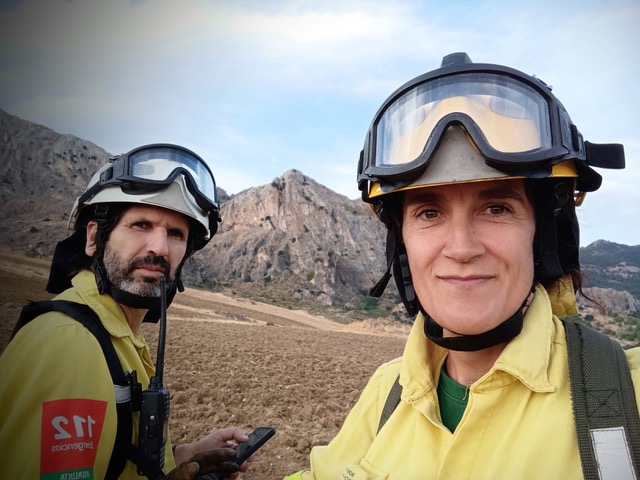
Isa and Pepe at work. Photo © Isa Moreno
The centre of the base is a huge helipad where a bright yellow helicopter is ready to take off. Next to the helipad is a pool - or ‘dip site’- where the helicopters fly in and fill their slings (called Bami-buckets), which can hold up to 1,300 litres of water. A couple of tanks ensure that the helicopters never run out of fuel, and a mechanic checks the engines on these warhorses daily.
Pepe explains: “The aircraft used in the firefighting work depends on the circumstances. The Fokker planes that collect water from the sea and lakes can carry up to 5,500 litres of water, but they cannot be manoeuvred in the same way as helicopters. Planes are often used at the front of the fire, while helicopters work along the flanks and in more difficult-to-reach zones. We also use smaller planes in which a red, flame-retardant compound is added to the water. This impregnates the vegetation and indicates to the ground crews and other planes where they have sprayed.”
The sun is starting to set, which means that helicopters and planes cannot be used until the next morning. Two of the operations centre's pleasant helicopter pilots, one from Bolivia and one from Portugal, are therefore going home.
«Helicopters are only used when the fire has been checked, and it is confirmed that aircraft are needed”, Pepe informs me and continues: “In Canada, where the forest is huge, air patrols are used to detect fires, but we do not have such large areas, so we utilise a surveillance network with guard cabins. Helicopters are also very costly to have in the air, and if we fly around looking for fires, we risk not being able to fly when we really need to, as the pilots can only fly for two hours before they must take a 20-minute break. We also use drones to pinpoint the perimeter and detect flammable areas using infrared radiation, as long as they don’t interfere with other aircraft. At night, when they cannot fly, the extinguishing work is done using ground crews with fire hoses and powerful all-terrain vehicles that can manoeuvre in steep terrain.”
“Actually, we get a lot of extinguishing work done at night, because the temperature drops and the humidity increases. At the same time, we can more easily see where the flames are”, Isa admits.
Causes and development of fires
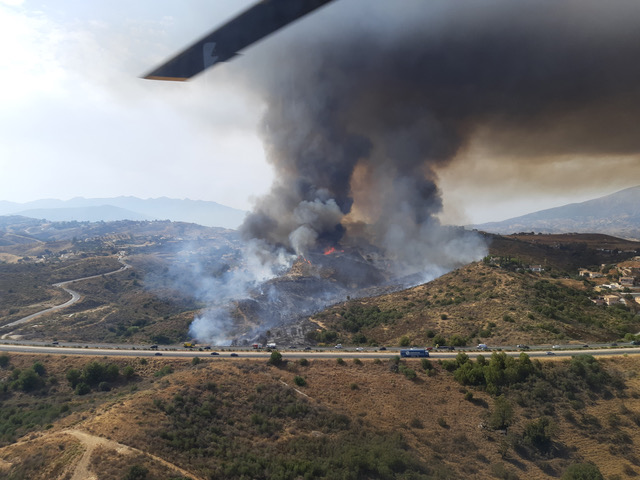
“In the past, more fires were started deliberately, especially by developers wanting to build in forest areas — but the law has fortunately changed.” Forest fire by Highway AP-7 near Costa del Sol. Photo © Isa Moreno/INFOCA
On high-risk days, a fire will likely break out somewhere in the western province of Málaga, especially on the Costa del Sol, which is drier, more populated, and has more housing and motorways that can lead to forest fires.
«Irresponsible actions and negligence cause most fires”, Pepe states.
During seasons with high forest fire risk, bonfires, barbecues, and burning in agriculture and the use of motorised machinery in forest areas are prohibited. These can create a spark, and that can be enough.
Infoca's forest fire investigation brigade can pinpoint exactly where a fire has started, but often does not know how or why.
“Unlike cigarette butts, broken glass or a lightning strike, no evidence is left behind if a fire is started with a lighter. When we were working in Toledo, the environmental agent showed us the starting point of a fire where we could see a perfectly burnt match!” Isa remembers and explains: “In the past, many fires were started, especially by developers who wanted to build in forested areas, but the law has fortunately changed. Even completely burnt-down forest areas cannot be rezoned for at least ten years. The law also prohibits the use of burnt material, so that no one burns forests for that reason anymore. Fire debris is left behind so nature can regenerate. Only in the case of exceptionally large forest fires does the Junta de Andalucía put them up for public auction as part of a reconstruction plan for the destroyed area.”
Forest fires have a diurnal cycle, with the greatest risk of igniting during the hottest part of the day. At the same time, climate change, with longer summers and shorter winters, has extended the forest fire season.

“I am not anxious at work, but I understand how overwhelming a forest fire can be the first time someone faces it.” . Photo © Isa Moreno/INFOCA
But the climate is not the only reason why forest fires are more severe today.
“In the past, people used the forest and brought fallen branches as firewood. Farm animals were taken to summer pastures in the mountains where they ate the undergrowth under the trees that now grow wild and can ‘feed’ fires. We have huge, abandoned forest areas. One of the few exceptions is the cork forests of Andalucía, where the surrounding vegetation is kept under control due to the harvesting of cork. As a result, these areas have fewer forest fires”, says Pepe, who regrets that the forestry is usually no longer enough for a family to live on, and everything requires permits. The authorities have initiated certain measures, such as subsidies for sheep and goat farmers who let their animals graze and keep the firebreaks clean. Otherwise, they grow back very quickly.
“In the winter, we do preventive work, such as maintaining firebreaks. It is almost impossible for a firebreak to stop the flames of a crown fire. But if the fire is moving slowly, they are very effective. They are also an escape zone for the fire crew and a safer place for us to work”, says Isa.
The best help is to stay away
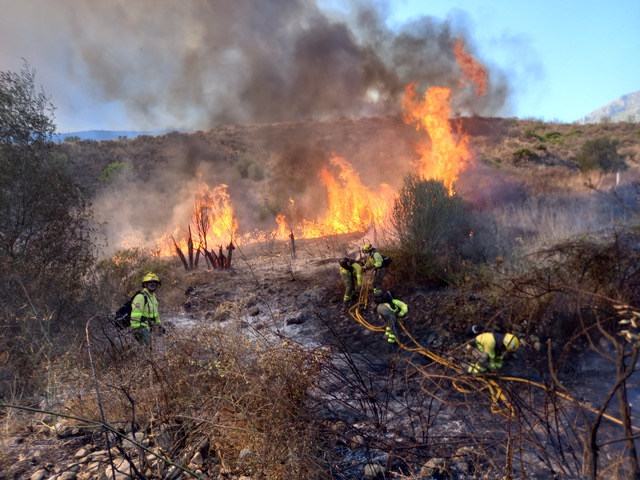
“Irresponsible actions and negligence cause most fires.” Photo © Isa Moreno/INFOCA
As professionals in the fire service, Isa and Pepe are grateful that people want to help in a forest fire, but their advice is clear: if you see a fire, call 112 and get away as quickly as possible.
“The problem today is that everyone calls 112 for every little cloud of smoke”, Isa regrets.
The emergency services receive endless calls from the San Pedro road, where the ‘fires’ often turn out to be people burning chestnut shells, because Andalusian farmers burn plant waste in the autumn
“The 112 service has taken us a big step forward, but Infoca must always confirm whether there is a fire”, Pepe says. He sends the nearest unit with an emergency vehicle, and if it is a small fire, the ground crew or the local fire department can put it out. But if there is the slightest doubt, they go out in the helicopter.
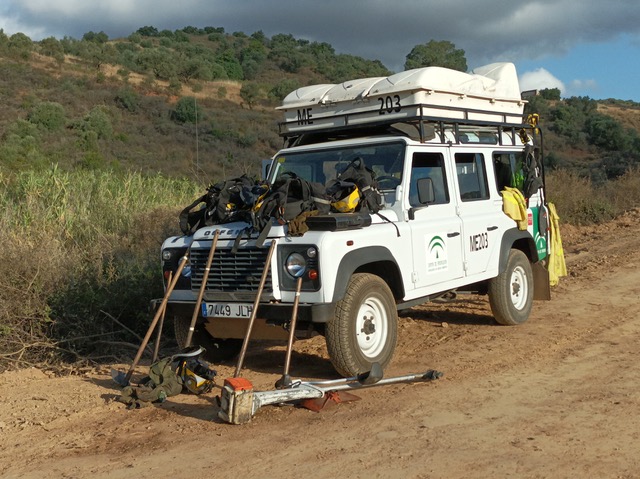
4×4 vehicle with equipment for each ground unit. Photo © Isa Moreno/INFOCA
A significant problem for forest firefighters is that people often park their vehicles near fires to see “what’s going on”, which can make it difficult for emergency vehicles to get through. However, it’s not just people who come to look and take pictures that can cause problems in these emergencies.
Isa’s advice is clear: “Many people see a fire and immediately think, ‘I want to go and help!’ It’s natural to react that way when you discover that the mountains around your hometown are burning, but if you don’t know what to do in a fire situation, you pose a problem. It’s important not to get in the way of the firefighters. I understand that people want to help, but it takes specialists to put out forest fires.”
“If a person walks into an emergency zone to ‘help’, I must neglect the fire, which is why I’m there, to take care of this person who shouldn’t be there”, says Pepe solemnly. “Our priority is always to protect human life, then homes and property, and finally forests and fields. So instead of managing the emergency, we must watch out for this person. Therefore, it is best to stay away and let us do our job.”
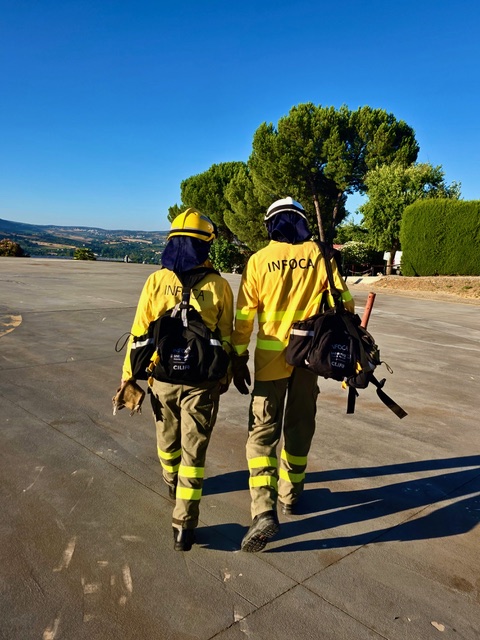
After a long day. Photo © Karethe Linaae