[© Freepik]
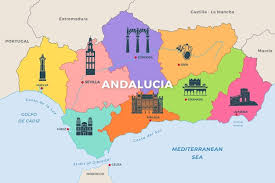
Andalucia welcomed almost 38 million tourists in 2025, a record for the region and 4.9 per cent more than the year before.
Every one of the eight provinces shared in that growth.
The beach is where most trips begin so for many people that means flying into Malaga. A great starting point for a road trip which takes in all eight provinces in the region and brings you back to Malaga again.
Malaga and the Costa del Sol
 Malaga makes a natural starting point for your journey, but it's well worth spending a few days in the city before heading west. In recent years Malaga has reinvented itself. Based around its connection to Pablo Picasso, born in the city, it is home to his Casa Natal (birth house) and the Picasso Museum. But Malaga is much more. It has a range of museums and the revitalised Old Part and the upgraded harbour area add to the city's charms.
[© Spain.info]
Add to that the excavated Roman amphitheatre and the views from Gibralfaro mountain and you can see why Malaga has jumped up the must-see rankings.
West of the city, the Costa del Sol is the most familiar part of the trip, with a string of resorts built around sunshine and long lunches in chiringuitos on the beach: Torremolinos, Benalmadena, Fuengirola, Marbella, Puerto Banus and San Pedro de Alcantara. A side trip up to Ronda from San Pedro is more than worth while and cries out for at least an overnight stay.
Back to the coast and we have elegant Estepona and a string of less developed resorts all the way to expensive and classy Sotogrande at the eastern end of Malaga province.
Cadiz and the Atlantic Coast
Skip Algeciras, an ugly port town. Instead head for Tarifa, the southernmost point in Europe. Here the Mediterranean and the Atlantic meet, making the winds ideal for a range of water sports. Hence, Tarifa has the feel of a surf town and the age profile is definitely on the young side.
Moving further west you come to Bolonia with its stunning beach and nearby Baelo Claudio, a well-restored Roman town.
Continuing up the Atlantic coast the terrain is much wilder than hitherto until you come to the hill town of Vejer de la Frontera, an absolute delight with its views over the coast. Nearby is the beach of La Palmera with its long sandy beach, part of which is an unofficial nudist beach.
 Eventually you come to the magnificent capital of the province, Cadiz city. An ancient port almost surrounded by water this city has everything. It is walkable and boasts a Camara Oscura, vibrant market, a stunning cathedral, fantastic restaurants and even a smattering of real ale pubs. Cadiz is my favourite provincial capital city in Andalucía.
[© ABC de Sevilla]
Leaving Cadiz, the route heads into sherry country: the manzanilla of Sanlucar de Barrameda and the sherry town, Jerez de la Frontera, where a bodega visit is de rigueur. Jerez is home to the Royal Andalusian School of Equestrian Art, which is also well worth a visit. Don't miss Arcos de la Frontera either, perched on a clifftop to the east of Jerez.
Sevilla, the regional capital
From Jerez the motorway reaches Sevilla in about an hour. The change of pace is immediate for the Andalusian capital is very extrovert, with flamenco and late nights part of everyday life.
Sevilla's monuments show how many different cultures have left their mark here.
 The cathedral claims to be the largest Gothic cathedral in the world. It is built on the site of the city's great mosque and its minaret survives as the Giralda bell tower. Next door the courtyards and gardens of thee Real Alcazar were shaped by centuries of Moorish and Christian rule.
Seville lends itself to walking, from the narrow alleys of the Santa Cruz quarter to the Plaza de España built in 1929 for the Ibero-American Exposition, and across the river to the Triana district where flamenco has its deepest roots.
Plaza de España
Huelva, off the beaten track
 This provincial capital is one of Andalucía's quieter spots, yet it is filled with history and nature. Christopher Columbus set sail from here in 1492 on his way to discovering the New World. A turning south off the A49 leads to the Doñana National Park, a stopover for vast numbers of migrating birds and home of the Iberian lynx. The village of El Rocio fills with pilgrims every year at Pentecost for the famous 'romeria'.
A famous landmark in Huelva
Cordoba, city of the caliphs
Leaving Sevilla on the A4, you follow the Guadalquivir river to Cordoba in less than two hours.
Cordoba is a dream and is my second-favourite provincial capital after Cadiz. It is quieter than Sevilla and best explored on foot.
 Cordoba's main attraction is the Mezquita, not far from the Roman bridge that crosses the river and adjacent to the Jewish quarter. The mosque became a church after the Christian reconquest of the city in 1236 and in the 16th century a Renaissance cathedral was built in the centre of the mosque, leaving the two side by side under the same roof.
It's the most spectacular building I have been in anywhere in the world.
[© Lonely Planet]
Jaen, olive country
 After Cordoba the route turns east and becomes more rural. Olive groves dominate the landscape, stretching as far as the eye can see. The province produces more olive oil than anywhere else in Spain.
Jaen sees fewer visitors than elsewhere but is nonetheless interesting. Less than an hour away are two gems, the towns of Ubeda and Baeza. Filled with Renaissance palaces and churches, the two towns share Unesco World Heritage status.
Beyond are pine forests at Cazorla, Segura and Las Villas, the three forming a designated Natural Park.
[© Wikipedia]
Granada, another jewel in the crown
Back in Jaen the A44 heads south to Granada in about an hour. The peaks of the snow-topped Sierra Nevada, home of Mulhacen. the highest mountain on the Spanish mainland, come into view long before the city.
 Granada is a university city with a Moorish past and has a younger more bohemian vibe than elsewhere.
The celebrated Alhambra sits above the city and below the mountains. Be warned, tickets for the main part of the site need to be booked well in advance.
A 'free' tapa with every drink encourages visitors to linger in the bars until late. In the Sacromonte, flamenco shows take place in caves cut into the hillside.
[© Traveler]
Almeria, Europe's only desert
From Granada the A92 heads east across a high plateau with the landscape becoming drier with every kilometre. Eventually, you reach the Tabernas desert, where many spaghetti westerns were filmed, including the Clint Eastwood trilogy 'The Good, the Bad and the Ugly'; 'For a Fistful of Dollars'; and 'For a Few Dollars More'.
 In Almeria City, a half-hour further on, you find the Alcazaba, one of the largest Moorish fortresses in Spain.
The main attraction of the province is the coast. In the Cabo de Gata - Nijar Natural Park volcanic cliffs shelter the coves and beaches which are largely undeveloped.
Mojacar looks out over the sea near the border with the Murcia region, so this is the end of the loop around Andalucía.
Mojacar [© Almeria is Different]
Back to Malaga along the coast
 The A7 heads back west along the coast and takes about three and a half hours without stops, However that would mean missing out on the towns along the Costa Tropical, such as Almuñecar and Salobreña. This area enjoys a micro-climate allowing farmers to grow a range of tropical fruits.
The final stretch crosses into Malaga province passes through the southern Axarquia before reaching the delightful Nerja, Frigiliana and Competa. We have enjoyed several stays in these pretty and vibrant white towns.
Frigiliana [© Malaga Hoy]
Then, in under an hour, we are back in Malaga City.
Last Word
This round trip needs at least a fortnight to do it justice. If you haven't got this much time in one go, it's worthwhile to split it into sections.
Whichever way you do it, you will find that Andalucía is a collection of very different places bound together by a shared history.
© The Spanish Fly
Acknowledgements:
Daryl Finch, Paul Whitelock, SUR in English, The Spanish Fly
Tags:
Alcazaba, Algeciras, Alhambra, Almeria, Almuñecar, Andalucia, Arcos, Baelo Claudio, Baeza, Benalmadena, Bolonia, Cabo de Gata, Cadiz, Cazorla, Columbus, Competa, Cordoba, Costa Tropical, Daryl Finch, Doñana, El Rocio, Estepona, flamenco, 'For a Few Dollars More', 'For a Fistful of Dollars', Frigiliana, Fuengirola, Granada, Guadalquivir, Huelva, Jaen, Jerez, La Palmera, Las Villas, Malaga, Marbella, Mezquita, Mojacar, Mulhacen, Nerja, Nijar, Paul Whitelock, Puerto Banus, Ronda, Sacromonte, Salobreña, San Pedro de Alcantara, Santa Cruz, Segura, Sevilla, Sierra Nevada, Sotogrande, spaghetti western, SUR in English, Tabernas desert, tapa, The Spanish Fly, 'The Good, the Bad and the Ugly', Torremolinos, Triana, Ubeda, Vejer