This time, however, it’s about both men and women – men and women who live in a country other than their own, for example Spain.
The current situation
At present in Spain, and elsewhere in the European Union, foreign residents from other EU member states are effectively disenfranchised, unless, in the case of Spain, they are empadronado, ie registered and on the electoral roll, when they may vote in local, regional and European elections, but NOT in national ones.
These arrangements are similar in other member states.
 Giles Tremlett, the distinguished journalist and writer, and Madrid correspondent of the Guardian, wrote an interesting piece in that paper, proposing an MP for the Costa del Sol.
His main argument then was that as a 15-year resident of Spain and a taxpayer, he does not have the right to vote in national elections in either Spain or the UK.
[Photo: Wikipedia]
He wrote: “Why not allow Britons living in [other parts of] Europe to vote in the national elections of their host country? Unfortunately neither the UK nor any other country in Europe seems to want that. As a result, I live in Madrid and pay taxes to the Spanish exchequer but have no say in how my tax money is spent.
He continued: “And therein lies another problem. For not only am I prevented from voting in a Spanish general election, but, as I have lived abroad for more than 15 years, I have no right to vote in the UK either. I pay tax but cannot vote. Whatever happened to “no taxation without representation”?
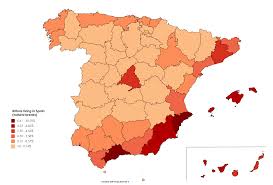 Tremlett pointed out that about a million Britons live for most or all of the year in Spain.
Of these, 352,000 have registered at Spanish town halls as being fully resident.
Hundreds of thousands of Britons live elsewhere across the European Union.
[Map courtesy of Reddit]
Those who left the country in the past 15 years, the vast majority, can vote in UK elections. Most, however, do not bother.
This is hardly surprising, since they must send their postal vote to the place where they last lived in Britain. People now living in Marbella, Torrevieja or Barcelona thus end up voting for candidates who are only interested in, say, the problems of Luton, Lambeth or Dumfries.
What do they care, or know, about hospitals, post offices and planned ring roads a thousand miles away? It is also not fair to the people living in those constituencies.
British communities abroad have their own problems, especially post-Brexit. Here in Spain, we worry about pensions, health care, the bureaucracy and the exorbitant price of consular services.
Even the winter fuel allowance – yes, payable in some circumstances – mattered to us. [Alas, that has long since been withdrawn, cancelled by David Cameron when he was prime minister of the Conservative/Liberal Democrat coalition government.]
Many of those suffering the catastrophic effects of a weak pound would like Britain to be in the euro. Many more of us have problems with local housing laws that they insist break EU rules.
Tremlett pointed out: “Britain frets about immigration but cannot be bothered to think about emigration. It should do. Of the hundreds of thousands of diaspora Britons with the right to vote, only 12,800 are registered to do so. Some 200,000 Britons move abroad every year, according to a study by the Institute for Public Policy Research. About 10% of all Britons, or 5.5 million people, live outside the country. ‘The UK government’s lack of attention to its large diaspora stands in contrast to the measures being taken in other countries,’ the study noted. ‘In the UK, talk of establishing a member of parliament for the Spanish costas, a new ministry for Britons living abroad or even a special parliamentary inquiry would most likely be laughed down.”
 Following the publication of Tremlett’s article back in 2020, the Guardian website was inundated with posts and the entry was closed after 118 comments.
[Image: Solopress]
Unfortunately many of the posts were very negative. As a British-born man who worked his entire career in the UK, but who has now, as an early retiree, decided to live in Spain, I was shocked by the many ill-informed and vitriolic comments posted there.
The “abuse” that was hurled at Tremlett on the Guardian website for daring to raise an extremely important issue is typical of the garbage I regularly come across in English-language newspapers and on their websites down here in southern Spain.
The excellent Olive Press website has unfortunately attracted an annoying cadre of bitter and twisted know-alls who post negative comments about Spain and the Spanish at every opportunity.
The Euro Weekly News continues to feature a weekly column by Leapy Lea and letters from his Daily Mail-reading acolytes who write in to support his racist and anti-Spanish rantings.
As far as I’m concerned the volley of criticism aimed at “ex-pats” – no, we’re actually immigrants, and uninvited guests, to boot – is all about envy and small-mindedness.
Although English-born, I am a fluent Spanish and German speaker. As a result, I am blessed with three separate social lives related to each language group, all of which I find fascinating, albeit different. Within those groups, most people, irrespective of their nationality, are mono-lingual. But I don’t think any the less of them.
I happen to be a trained linguist; they are trained carpenters, electricians, police officers, sales executives, hoteliers, lawyers, all skilled in their own fields. Many of them have tried to integrate and learn Spanish and are successful to varying degrees. But they are all committed to living here, are resident, registered on the padrón and, on the whole, pay their taxes here.
 There are indeed stereotypical British immigrants, known as guiris, and I chuckled at Frank Little’s five definitions on the Guardian website thread, because I know people who fit each of the categories.
Fortunately, there wasn’t one into which I and many of my friends would fit.
A stereotypical guiri [anonymous]
What's the solution?
The answer to this representation problem is quite simple and was identified by many posters on the Guardian website. If, as an EU national, you are tax resident in another EU country, you should have the right to vote in all elections, local, regional, national and European in that country, and not in the country of your birth. Simple, straightforward, no argument.
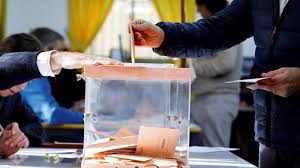 Except that policy has not helped British residents since 1 January 2021 onwards, since we are no longer EU citizens. What about letting all foreign, tax-paying residents have the vote in national elections. Doesn’t that make sense?
The sooner Brussels takes note of this and changes the law to remove the current anomalies, the better.
[Photo: RTVE.es]
And as for those who criticise, perhaps on the grounds of envy, those of us who have legitimately moved countries within the EU, well, perhaps we should just ignore them.
© Paul Whitelock
Pictures:
RTVE.es, Reddit, Solopress, The Guardian, Wikipedia
Thanks:
Giles Tremlett, Paul Whitelock, The Guardian, Wikipedia
Tags: