Andalucía Day (Día de Andalucía)
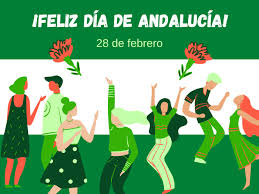 Andalucía Day, marks the anniversary of a referendum held on 28 February, 1980 when a large majority of voters supported the referendum for Andalucía to become one of the 17 autonomous communities in Spain, following Spain’s democratisation after nearly forty years of the Franco dictatorship. Franco died in November 1975.
[Image courtesy of Calendarr]
Día de Andalucía is a significant day in the life of most andaluces. It is a public holiday so that schools, businesses, and government offices are closed.
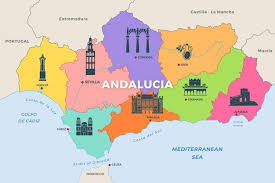 The autonomous community of Andalucía shares international land borders with Portugal and Gibraltar. Within Spain, it borders the autonomous communities of Castilla-La Mancha, Extremadura and Murcia. People in Andalucía voted for the region to become an autonomous community of Spain on February 28, 1980.
Yet the Spanish Parliament only accepted Andalucía as a historic nationality in 2006.
[Freepik]
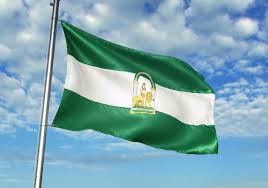 Andalucía’s flag is widely displayed on Andalucía Day. It consists of three equal horizontal bars. The top and lower bars are dark green and the middle bar is white. Andalucía’s coat of arms is at the centre of the flag. Andalucía’s coat of arms consists of an image of the mythical Greek hero Heracles between two columns. The columns represent the Pillars of Heracles. These are the rocks on either side of the Straits of Gibraltar.
[Junta de Andalucia]
In many cities, towns and villages in Andalucía people decorate their balconies with the regional flag and with green-and-white bunting.
***
Fiona Flores-Watson and Catherine Cunningham wrote a thorough description of this day for the website andalucia.com. Here are some excerpts:
What happens on Día de Andalucia?
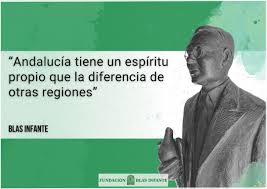 On Día de Andalucía politicians and officials traditionally pay tribute to Blas Infante by visiting his monument at km 4 on the old Seville - Carmona road, site of his execution at the beginning of the Spanish Civil War. This act serves as a tribute to his legacy and his contributions to Andalusian autonomy and culture.
There are also groups who pay tribute to Blas Infante by visiting his birthplace in Casares, and also at the Casino and Circulo de Artistas in Ronda, where he held the first Andalucian assembly in 1918.
[Instagram]
For those whose children attend school in Andalucia, if 28 February falls on a Tuesday or Thursday, then the intervening Monday/Friday will be added to form a “puente”, or bank holiday.
On the day before, or the last school day prior to the Andalucia Day holiday, children in primary schools have a traditional Andalucian breakfast of toast with olive oil plus orange juice.
Many towns and villages will have small flag raising ceremonies in the main square in front of the Town Hall on the morning of 28 February.
Cities and towns across the region come alive with festive activities. Schools, government buildings, and houses proudly display the green and white Andalusian flag for days or weeks leading up to 28 February.
Some museums and monuments open for free, such as the Museo Picasso and Centre Pompidou in Malaga, or hold special visits and events - check schedules in advance.
The history of Andalucia and Blas Infante
Historically, Andalucia has been shaped by many civilizations, including the Phoenicians, Romans, Visigoths, and Moors, before the reconquest of Iberia by the Catholic Monarchs in 1492.
 Later, in the early 20th century, politician, writer and activist Blas Infante (1885–1936) played an important role in defining Andalucia’s identity.
Infante is considered the "Father of Andalucian Nationalism", thanks to his advocating for its autonomy.
[Diario AS]
But Blas Infante’s activities were not considered acceptable by General Franco, and he was executed by the dictator’s troops on 11 August 1936, on the old Seville - Carmona road. The final words spoken by this champion for his beloved region were: “¡Viva Andalucía libre!" (Long live free Andalusia!).
The influence of Blas Infante on Andalucia during the 20th century’s first tumultuous decades laid the foundation for the region’s recognition as an autonomous community within Spain in 1981, following the referendum the year before.
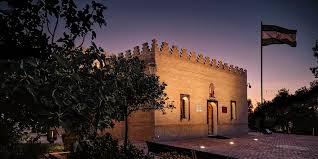 His house, Casa de la Alegría, in Corea del Rio near Seville, now forms part of a museum, Museo de la Autonomía de Andalucia.
[ABC]
While Andalusia as a region has ancient roots, Blas Infante, born in the small village of Casares in Malaga province, is credited with giving Andalucia its modern political and cultural identity.
The flag's design was overseen by Blas Infante, as part of his key role in shaping Andalusian identity.
My Andalucia Day 2024 - a personal serendipity
I had a great day, much of it unexpected yet good, therefore serendipitous.
After early coffee in the Ronda Valley Hotel (now the Hotel Don Manuel), my local in Ronda, I headed off to Montejaque to do some work on my reforma in the village.
Guess who was there? My new neighbours who bought the house next door 12 months before. Robert and Edyta are Poles from Warsaw. I didn't know they were coming. That was quite unexpected and it was a pleasure to see them again.
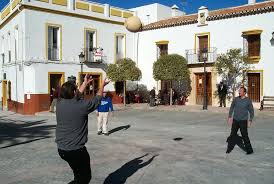 It was now midday, so I popped to the square to watch El Juego del Cántaro, a tradition in the village on Andalucia Day. First up were the young kids from the village, followed by the macho twentysomethings - all of them male. Then it was the turn of the older women and at the end they wanted the guiris to form a group. I was roped in, together with Jane and Samantha, all of us English. The Germans and the Americans present all declined to take part, however! Three local women made up the numbers.
[Diputacion Provincial de Malaga]
All three of us English were debutants, despite living in the village for many years. We gave a good account of ourselves and managed to keep the pitcher in play for a good quarter of an hour. Then a mortified montejaqueña dropped it, whereupon it smashed into a thousand pieces . Game over! Our guiri honour was intact!
Next I set off for the next village down the Guadiaro valley, Jimera de Líbar, for a live music gig at Allioli Bar Y Más, the bar by the station, where I had arranged to meet some friends, locals, as well as a Scotswoman, a Danish lady, a Scouser and several other British folk.
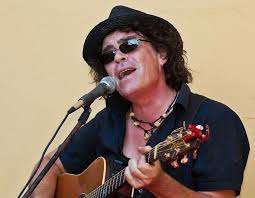 The group was EQUIS, so called because X (equis in Spanish) is the letter used for foreigners (extranjeros) on NIEs and TIEs and the group members are all foreigners: Marcus, English, on lead guitar and vocals; Lindsay, also English, on keyboards; Klaus, German, on bass guitar and vocals; and Franci, from Gibraltar, on drums.
Incredibly, although I have known Marcus Myers for many years, I had only ever seen him perform solo.
Marcus Myers [marcusmyersmusic.com]
EQUIS were a revelation. They played superb covers of The Beatles, the Rolling Stones, The Who, The Doors, Joe Cocker, Santana and The Police.
I then went home to Ronda. I was on cooking duties, as my missus Rita was on the coast with her German friend Helen.
Dia de Andalucia Dining 2025
Friday 28 February 2025 - Celebrating with dinner
Because of the bad weather some of the outdoor celebrations had to be cancelled or moved to indoor venues. And the andaluces still enjoyed their celebrations with family and friends.
Those of us foreigners who are resident here – guiris – will have used the day as an excuse to celebrate and many will have gone out for dinner.
The Meter Maid and I chose the nearest restaurant to our home, the excellent La Cascada at the Hotel Molino del Puente in Fuente de la Higuera just outside Ronda.
The hotel ba.jpg) r was cosy and warm; the restaurant also.
r was cosy and warm; the restaurant also.
There were 18 diners, eight Spaniards and ten “guiris”, a mixture of hotel residents and “locals”.
After opening drinks in the bar we chose our meals and shortly afterwards adjourned to our tables, where we dined in style - as always.
Ian, Elaine and Carly Love with head chef Tom O'Connor
***
Día de Andalucía is a day to embrace the rich cultural heritage, enjoy delicious food, and take in the lively atmosphere that makes Andalucia so very special.
¡Feliz Día de Andalucía!
Further reading:
Andalucía Day (Día de Andalucía) - Secret Serrania de Ronda - 2021
Día de Andalucía – Monday 28 February 2022
My Andalucia Day - a personal serendipity – 2023
Por qué se celebra el 28-F el día de Andalucía
Early Morning Coffee
What is a guiri?
© The History Man
Photos:
Daily Mail, Ian Love, Karl Smallman, Paul Whitelock, saedyn
Acknowledgements:
Eye on Spain, Ian Love, Karl Smallman, Paul Whitelock, Secret Serranía
Tags:
17 autonomous regions, 28 February 1980, andaluces, Andalucía, bad weather, celebrating with family and friends, Daily Mail, death of the dictator General Franco, democracy, día festivo, Eye on Spain, guiri, Hotel Molino del Puente, Ian Love, Karl Smallman, La Cascada, Meter Maid, outdoor celebrations, Paul Whitelock, political and cultural history of the region, referendum, resident, Ronda, Secret Serranía
áéíóú