Mallorca is one of Europe’s most desirable places to live — but it is also one of Spain’s most expensive. Understanding whether the lifestyle justifies the cost is the key question for most people considering a move.
What makes Mallorca different is not just the climate, but the rhythm of life: mornings at a café in Palma’s Santa Catalina, year-round outdoor living, and a pace that feels distinctly Mediterranean even in the capital. With a resident population of around 900,000, the island functions well beyond the summer season — but what ‘year-round’ actually looks like in practice is something this guide explores in detail.
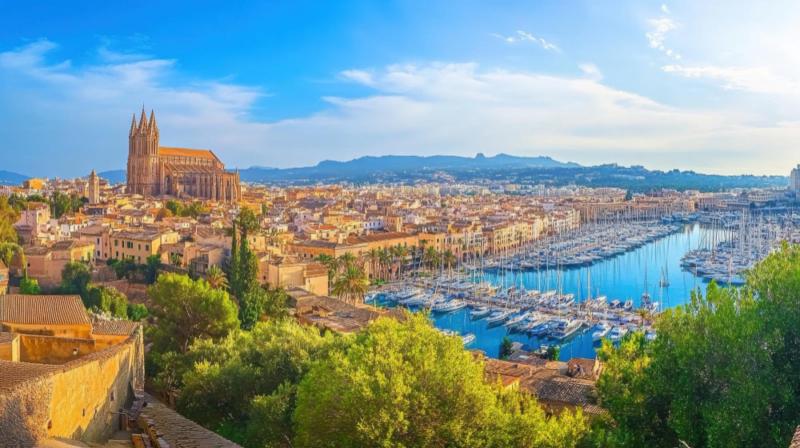
Palma de Mallorca combines historic architecture, a large marina, and year-round urban living by the Mediterranean. Source: Freepik
Is moving to Mallorca a good idea?
For the right person, absolutely. Mallorca suits those who prioritise Mediterranean climate and outdoor living, a stable property market, access to international schools and private healthcare, and strong flight connections across Europe. It works particularly well for retirees — there are nine compelling reasons why Mallorca consistently ranks among the best places in Spain to retire. It also suits remote workers, business owners, and those with income generated outside the island.
It may not suit those who:
- Are working to a budget below €2,000/month excluding rent
- Need access to a large corporate or public-sector job market — local salaries in tourism and hospitality are modest relative to the cost of living
- Rely on public transport; a car is essential almost everywhere outside Palma
- Expect fast administrative processes — registrations, residency cards, and bank accounts take longer than most newcomers anticipate
- Are buying property to let short-term: tourist rental licences are now tightly restricted across the island
Language and daily life
Mallorca has two official languages: Spanish and Catalan, specifically the Mallorquí dialect. In practice this means signage, official correspondence, and local bureaucracy often appears in Catalan first. Public schools teach primarily in Catalan. In Palma and heavily international areas, English and German are widely spoken, but outside these zones, Spanish is the working language and Catalan the community one.
This genuinely affects integration. Learning conversational Spanish makes daily life significantly smoother; making an effort with Catalan — even basic greetings — is noticed and appreciated by local communities. For those planning to settle in smaller towns or inland villages, some language capability is less an advantage than a practical necessity.
Climate and the off-season reality
Mallorca enjoys a Mediterranean climate with over 300 days of sunshine per year. Summers are warm and dry — July and August regularly reach 28–30°C — while winters are mild, typically settling between 10–15°C. Spring and autumn are arguably the most pleasant seasons, particularly for hiking, cycling, and sailing.
What the climate figures do not capture is the off-season reality of many coastal and resort areas. Between November and February, a significant number of restaurants, shops, and leisure facilities close. Communities thin out. In heavily seasonal towns, this can feel isolating, particularly for people who moved expecting a permanent version of their holiday experience. Palma and the major inland towns maintain a full year-round rhythm, but buyers drawn to quieter coastal areas should spend time there in winter before committing.
Transport and connections
Palma de Mallorca Airport (PMI) connects the island to 87+ destinations via 36 airlines, with year-round direct routes to London, Frankfurt, Amsterdam, Zurich, and Madrid. Within the island, public transport covers Palma well, but is limited elsewhere.
Key realities:
- Driving from Pollença or Alcúdia to Palma typically takes 45–60 minutes
- Summer traffic on coastal roads in July and August can add significantly to journey times
- Rural areas have minimal bus frequency — often a few services per day at most
A car is effectively essential outside the capital. Budget €200–€400/month for ownership costs including insurance, fuel, and maintenance.
Taxes: what you need to know before you move
Spain’s tax system is complex for new residents, and the Balearics have specific considerations — including a reintroduced wealth tax and strict worldwide income declaration rules. Depending on your circumstances, qualifying newcomers may also be eligible for a favourable flat tax rate under the Beckham Law. If you own a property before establishing residency, you will also be liable for non-resident income tax under Modelo 210, even if the property is unoccupied. Tax planning should happen before you arrive, not after — our tax guide for expats in Spain covers the main obligations in full.
Cost of living in Mallorca
Mallorca is the most expensive region in Spain by property value, but everyday costs remain moderate by northern European standards. The figures below are indicative estimates based on typical costs reported by Numbeo and Freedom Abroad (2025–2026):
Read more at thinkSPAIN.com